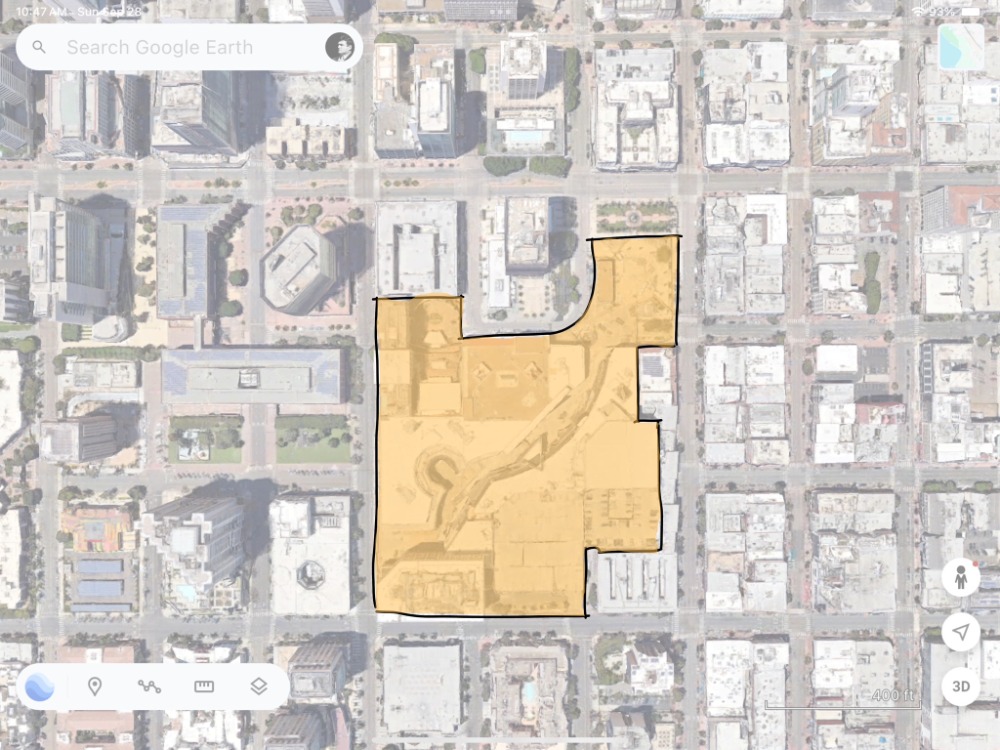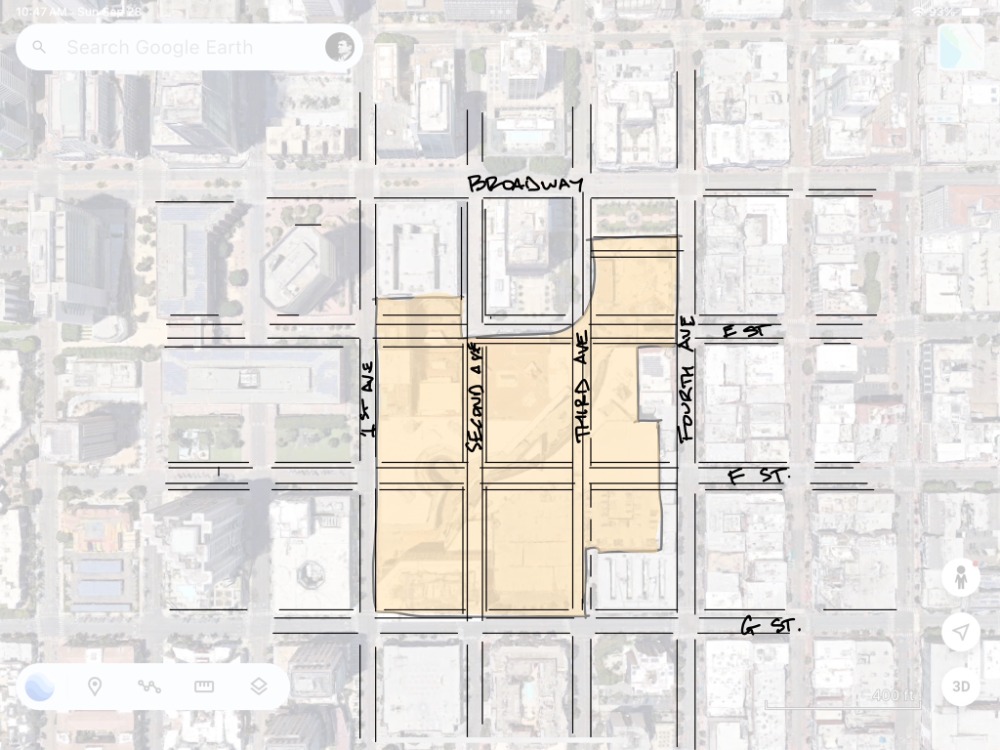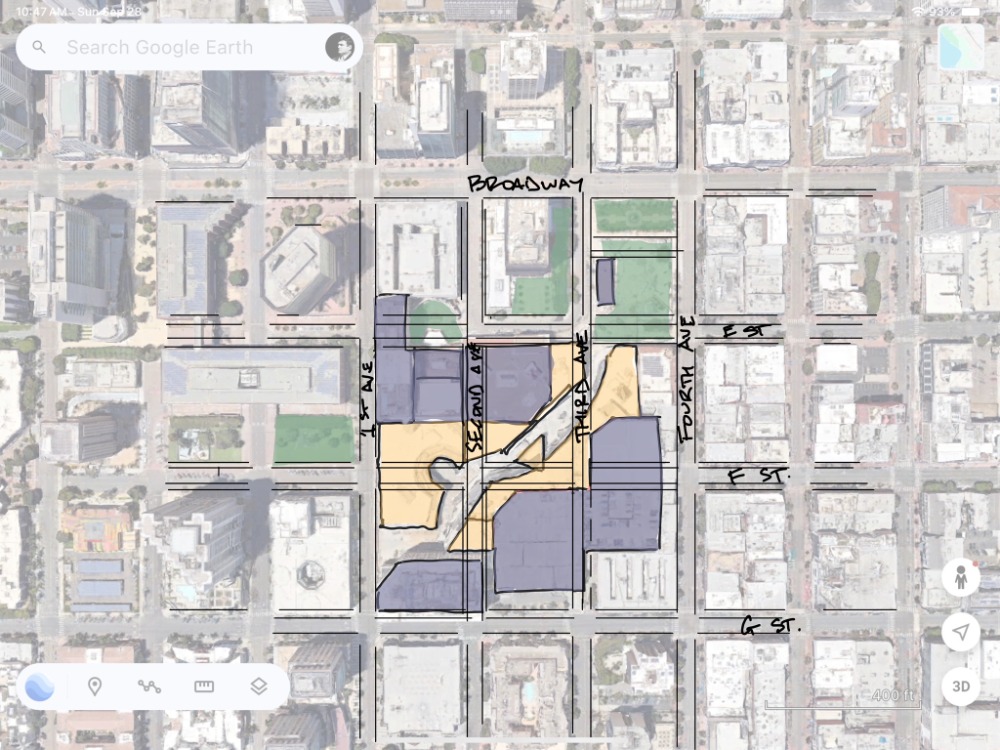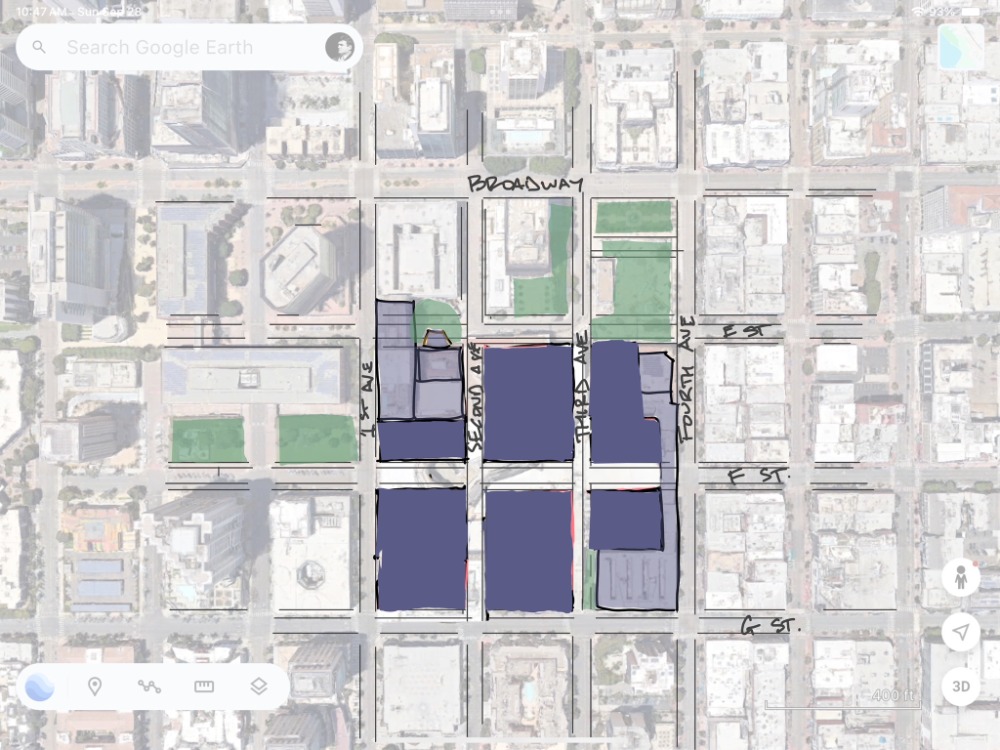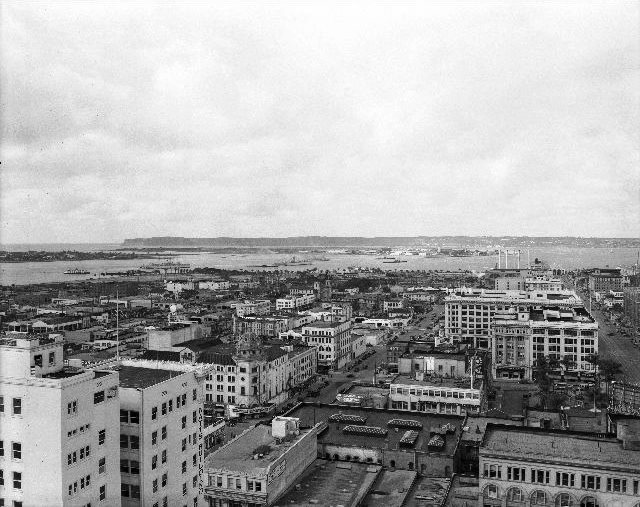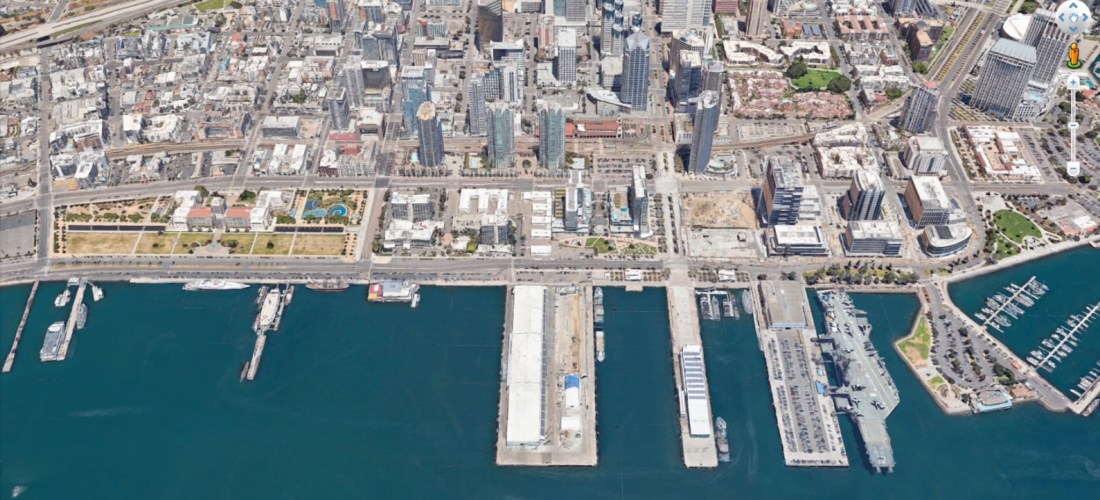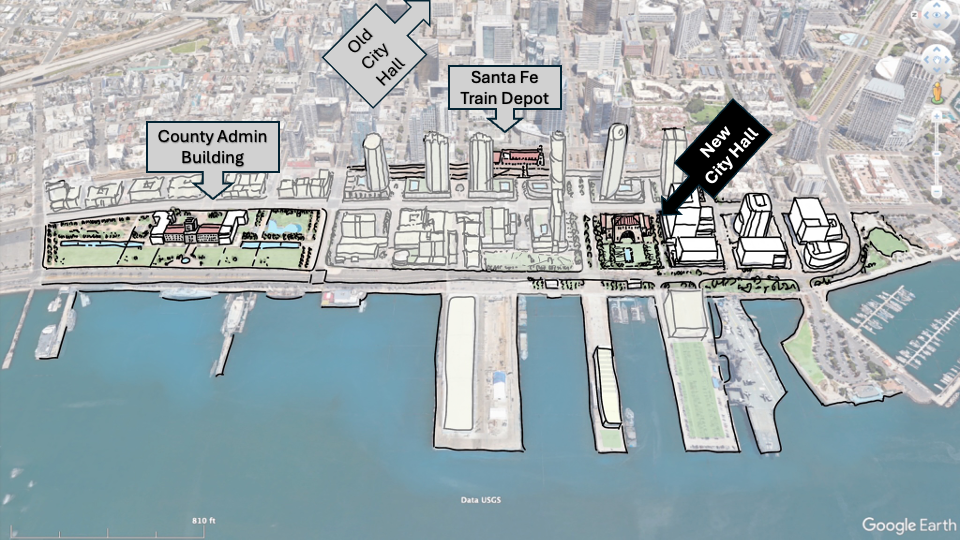
Existing Context

A City Hall Worthy of San Diego

Public Space, San Diego, Urban Design

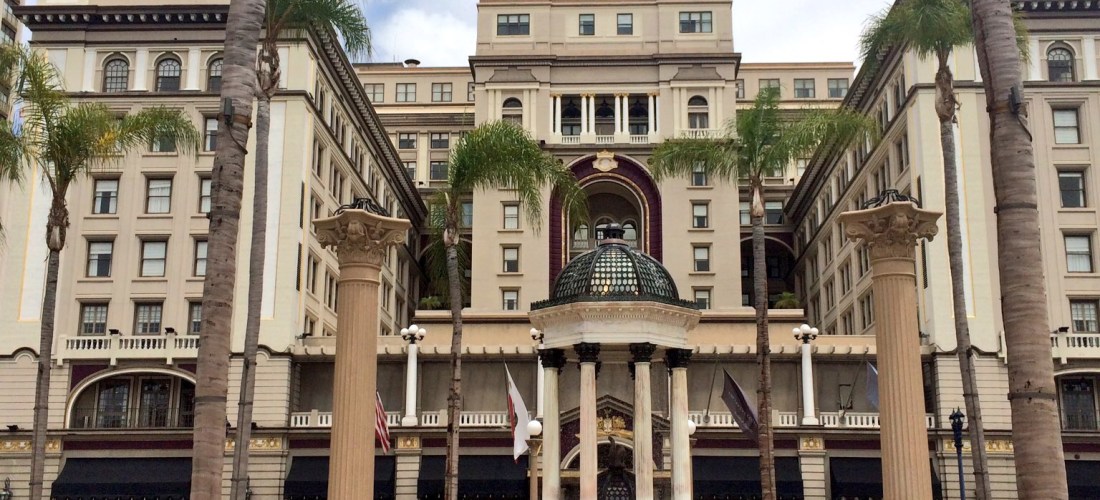
Let’s Rethink City Hall… and put it back on our waterfront! Let’s show our civic pride in reconnecting the city to our great bay! And all of these IQHQ buildings are empty anyway. We can trade Papa Doug Manchester 101 Ash for the Broadway & Harbor block, and build a great and beloved grand City Hall. City can lease the existing buildings for administration/staff offices and everyone, from citizens to staffers, will feel good about going to the bayfront to govern our great city.
San Diego has a history of moving (after burning it down down) city hall, starting in Old Town (burned), then to Market & 5th, Waterfront, and C Street (should be burned), which has never been a beloved place anyway. It too was just a development scheme by C. Arnholt Smith… let’s make it work for us this time.

Our important civic buildings should be located on our best sites, and Broadway & Harbor is that. Use the C Street land sale $$ to build a new Chamber/Hall on our best site. And let’s be proud of how we govern our great city on the bay.

How I Got Here…

Leon Krier, San Diego, Urban Design

First, one of the many reasons I owe Mr. Michael J. Stepner, FAIA, FAICP, more than I can ever repay him is because he helped me find my professional path. My career as a planner started in Honolulu and then San Diego. I remember reading in the newspaper about Mr. Stepner being fired by a crude City Manager, Jack McGory, and then hired back by the city council, who overruled Jack, because he was rightfully leading San Diego towards its mixed-use, walkable, transit-supported future. Mike’s story resonated with me and that he had great credibility.

Second, here’s my new urbanist origin story. I was working for an architecture firm in Daegu, South Korea, during the Asian Tiger economic boom from ’93 – 97. And I found myself designing their first retirement communities using my suburban SoCal drive-thru lifestyle design tools. Traditionally, Korean elderly give their inheritance to their children when they moved in with their children’s family and they lived together in their compound housing (totally different from modern Western civilization tradition). And I designed their first car-oriented ‘silver towns’ because the middle class and car ownership was rising and they had money to put their elderly in homes. I met with the owners and looked into the sad eyes of one of the elderly men in the room who was envisioning his life isolated in a retirement box, alone.

I realized I was destroying a culture and that I had power as a designer and with great power comes great responsibility (credit: Stan Lee). So I knew I needed a deeper understanding of my craft and further my education. So I starting searching…

Around that same time, 1997, I took a job in Singapore to master plan port facilities with housing for imported labor… and none of those cheaper laborers imported had a car. These were exclusively walkable neighborhoods for 1,000s of workers. If the port facility was in Malaysia, they brought in Indian workers, if in the India, the brought in Philippine workers, and so on. Going into the interview, I remembered reading about Mike Stepner designing walkable, transit-station areas in San Diego and hiring Peter Calthorpe. So I bought Peter’s book, The Next American Metropolis, read it on the 30+ hour flight, copied his drawings into my notebook that I showed at the interview and got the job.

In Singapore, I found an older Calthorpe and Sim Van der Ryn book (’91), Sustainable Communities, and on the last two pages, they reference Leon Krier as the future guru of planning sustainable communities. Of course Leon is the godfather of the Congress for the New Urbanism because he taught at Yale when Peter, Andres Duany, Liz Plater-Zyberk, Stefanos Polyzoides, and Andrew Malick’s father were students there. And down I went, into the Leon Krier rabbit hole. Amazingly, within my own profession, I found the innately humane power in building walkable places that people loved. And it energized my career.

Unfortunately, in ’98 my father passed away but it left me enough money to go get my Masters in London (Univ. of Westminster, ’00) and put money down on a house in San Diego (’01). I went to London specifically to learn from Leon as I interned with the Prince’s Foundation, but I didn’t get to meet Leon…

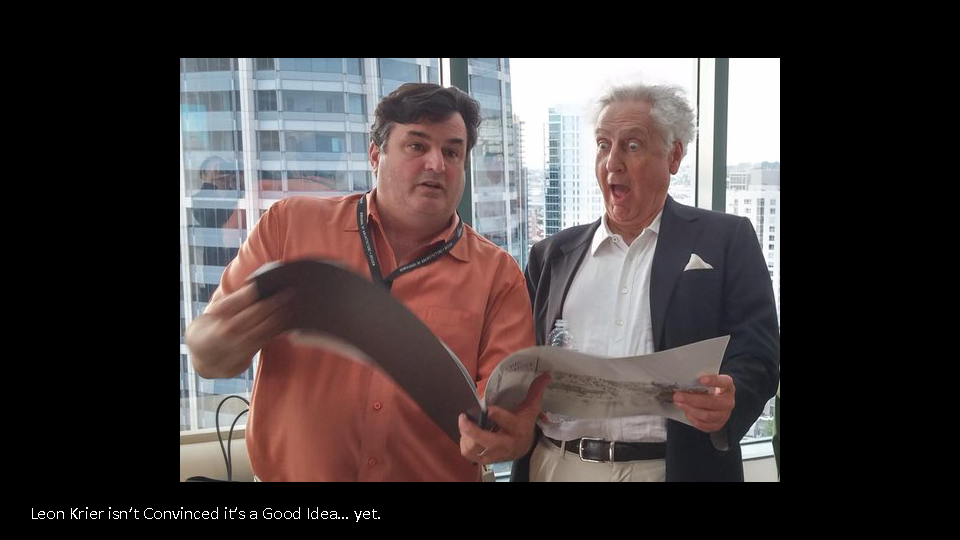
Returning to San Diego, I worked on the County of SD General Plan Update and I’m asked by an NU colleague to go on a charrette in Chico, CA (’04), led by Leon Krier! My boss said I couldn’t take the time off to go so I quit the County and went (they hired me back as they didn’t expect me to quit). I purposely watched Leon and immediately sat at the same table as him, along with Geoff Dyer, who’d become my business partner and dearest friend. We sat there, stole scraps of drawings, listened, learned, copied, and soaked in the charrette that was a beautiful mess. Leon knew my London teachers and Princes Foundation colleagues and we became friends.

From there, Leon and I spent time together at New Urbanism’s annual Congresses. And when his book, The Architecture of Community, came out, he came to San Diego to lecture in Balboa Park, and we packed the Photograph Museum theater to the rafters, which was real meaningful to Leon at that time. He came back again a couple other times and together we drove my convertible Porsche across the desert for him to lecture at Univ. of Arizona. A memorable moment at one of his lectures in the NewSchool of Architecture, he asked the audience if anyone in the room had ever designed a tower… and in the front row, only Frank Wolden raised his hand!

We were able to spent a lot of time together then and during Covid, when he was trapped in his Cayala, Guatemala, studio for several months, we recorded these vlogs (and here) to talk about design, history, philosophy, and beyond.

And while in San Diego, he’s come up some of his more recent ideas that he’s published and we continue email debates on topics/issues, such as Corbu/Speer and vertical transects. His design idea for Coronado’s toll booth landing area is brilliant, using different height columns in a circle appear to ‘move’ when driving across the curve of the Coronado Bridge. 3-dimensional thinking. Here and here are a couple of links on his visits to San Diego.

My Taco Shop Theory…

Economics, San Diego, Urban Design, Urban Planning, walkability

I write, draw, and lament often about how great mixed-use, walkable, transit-supported urbanism is for our civilization. In my part of world, San Diego, one our most civilizing characteristics is the local taco shop(s). Taco shops are ours and we do them best, especially in comparison to LA, ‘Frisco, and Sacramento. And I have a theory… “the best taco shop is the second closest taco shop to your home.”

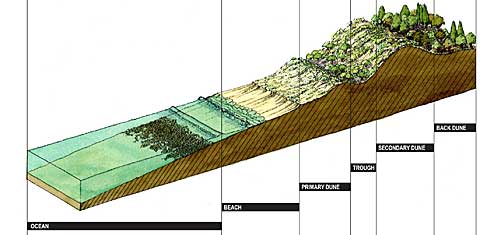
Another theory I subscribe to is the use of the ‘transect’ to design, plan, and build neighborhoods. The transect is an environmental research tool. It is a cut or path through part of the environment showing a range of different habitats. Biologists and ecologists use transects to study the many symbiotic elements that contribute to habitats where certain plants and animals thrive. The urban-to-nature transect outlines our human habitat in a similar fashion. See here: https://transect.org/index.html

natural transect
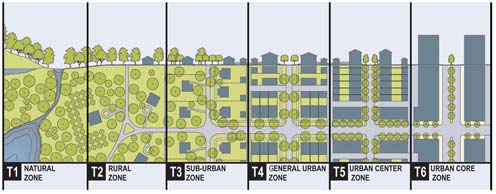
transect

And the Transect Zones (T-zone) range from the most urban, T6, to the most natural, T1. And there are 4 other place types in between. The Transect can be used at the regional scale. For example downtowns are a region’s most urban, thus T-6, and State/Federal parks, T1, are the most natural areas that need to be preserved. Agricultural reserve areas (T2), edge of town suburbia (T3), small town centers (T4), and the middle of towns/cities neighborhoods are mixed-use (T5). And the Transect is best applied at the neighborhood scale.

Each walkable neighborhood, approximately 120-acres, .25 mile distance from center to edge (approximately 1,250 linear feet), and these have at least 3 transect zones within it to provide a mix of uses, places, spaces, and people at different income/life levels. The neighborhood main street center is T5, the neighborhood general area with a few corner stores is T4, and the neighborhood edge is usually T3 that leads to natural corridor or the next neighborhood edge leading to another neighborhood and its main street center.

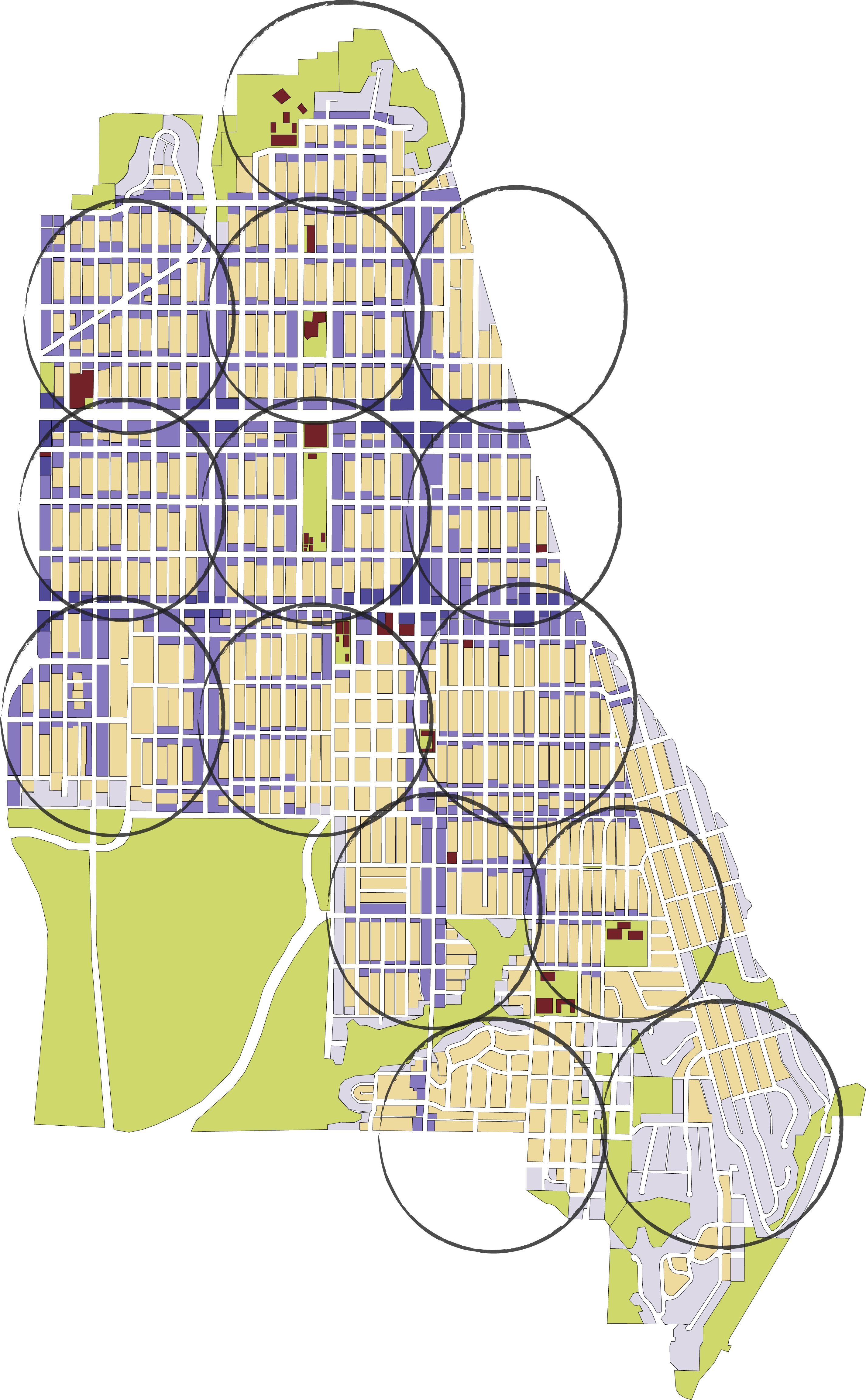
This my complete, walkable, mixed-use, transit-supported neighborhood with the 5-minute walk from the neighborhood center to edge outlined:

And here are where my local taco shop and trucks are located by Transect-Zone:

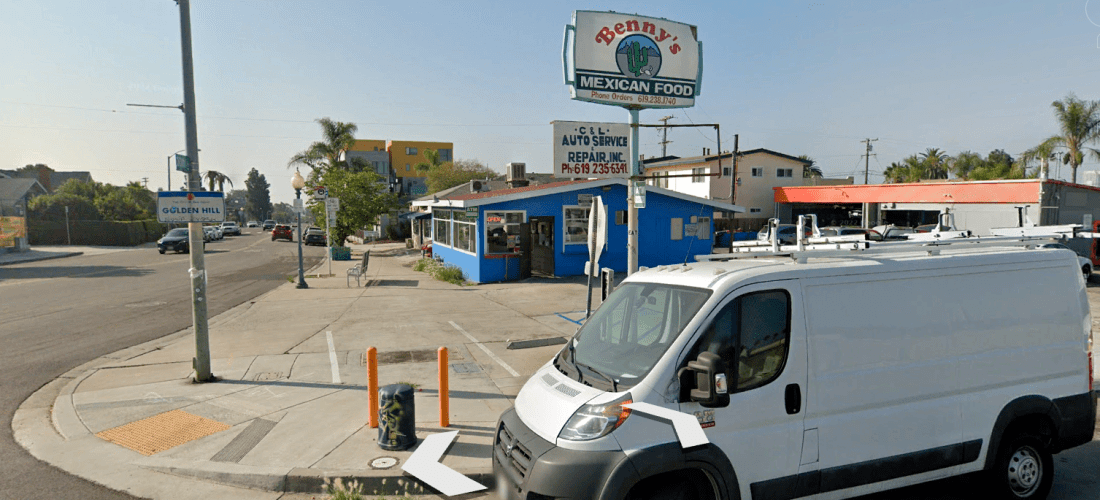
And here is the location of my next and favorite taco shop:

If I took the time, you’d see that my favorite taco shop is on the edge of the next neighborhood to my south. It’s center is located a neighborhood grocery store (Food Bowl, who make great tacos in their deli too). And our older streetcar neighborhoods in San Diego are expertly shaped with neighborhood centers located every 5 to 10-minute walks apart from each other and our #2 Bus stops. And, every neighborhood essentially has a great taco shop located in it. To the north, The Taco Shop is located another half-mile to the north, then another favorite taco shop, open 24-hours, Saguaro’s, is another half-mile from there.

Below is a transect map of the neighborhood’s in the North Park Community Planning Area. My neighborhood is to the furthest south (and half in Greater Golden Hill). The Taco shop is on the edge of the next north neighborhood (see the off-set Upas St intersection). And Saguaro’s is on the edge of the next neighborhood to the north, and so on. Notice they’re all located on 30th Street, the only north/south street connected South Park/Golden Hill to North Park and all of the tacos shops are located on it (and Fern St where it changes names).

One of San Diego’s best cultural elements are our taco shops. When I travel somewhere for more than a few days and return… my first meal home is usually from a taco shop because I need it. And we’re fortunate enough to have a taco shop in most of our urban neighborhoods. I’m thankful for my local, but I eat there too often and it’s staled to my tastes… and it’s too close. A 5-minute walk to/from my house to my local taco shop only burns a few calories compared to the amount of calories served up by my favorite burritos, rolled tacos, and flying saucers.

Theories…

San Diego, Urban Planning

I believe your favorite taco shop is the one that’s the 2nd closest to you. Because you eat at your local taco shop too often, so it gets dull… while being thankful its there. But that 2nd closest shop?!? Yeah, that’s the one that has the stuff that have to make an effort to get there and it’s just that much better than your local shop.

I believe this to be true.

I believe San Diego doesn’t have a parking problem, it has a walking more than 50-feet problem. In fairness, I’ve seen Marcela Escobar-Eck, a San Diego consultant, tweet this before too. But, I see people driving in circles to find that as-close-as-possible space, complain about parking, and not just drive to the edge of the parking lot or a block over and walk to where you want to be. It’s silly and selfish… but we’re from silly and selfish stock.

I know this to be true.

I believe what Mike Davis was absolutely brilliant and wrote the best pieces on social equity and inclusion/exclusion than anyone in our business. He was as kind and giving as he was brilliant. A giant, lost.

And I think this is true.

Family is the basis/core of civilization. Our sense of belonging or home or family (groups) equates to providing us a moral responsibility to take care of each other and our home(s). This does not apply as innately to global-scale industries, economies, businesses, politics, and environmentalism. That’s a reason for the disconnect between mitigating for global warming, building a traditional neighborhood, and living in a suburban cookie-cutter house.

San Diego/Tijuana is a World Design Capital

San Diego, Urban Design

This is an excellent article about the need for design innovation in SoCal, and very apropos to San Diego. In short, the author explores ideas about the need to ween ourselves off of our car culture and recommends Building Expositions: Design thinking is applied to urban design through rapid urban prototyping, and as such through the primary tried and proven vehicle of international building exhibitions, which have had a successful track record for more than a century.

San Diego/Tijuana has a history of important building innovations, starting with San Diego’s two early 20th century world expositions. First with the invention of Spanish Revival in 1915 by Bertrand Goodhue, and then with suburban sprawl in 1935 by the Federal Housing Authority. The suburban auto-oriented pattern of building was first exhibited in ’35’s FHA suburban model homes by Neurta and Eckbo, and it changed the world.

In the 1950s, San Diego also invented Climate Change (Scripps GhG/carbon measurements by Roger Revelle and Charles Keeling), which dramatically changed our world too. We invented the modern LRT system, Transit-Oriented Development (Peter Calthorpe/Mike Stepner), modern ranchette house (Cliff May), modernist tilt-up construction (Irving Gill), Salk Institute (Lou Kahn), downtown urban malls (Jon Jerde/Frank Wolden), and we have UCSD’s Teddy Cruz’s study on cross-border construction techniques found nowhere else. Our latest UCSD/Tijuana Migrant Shelter (Teddy Cruz/Fonna Forman) and Cross-Border Terminal (Ricardo Legorreta/Blackson – yeah, I did the Site Plan) are important innovations too. Our bordering cities have a successful history of building innovation that needs to be celebrated.

This is the value of next year’s WDC2024. The World Design Capital is a legacy thread that builds upon our history of innovation and has the potential to reshape our future.

Buildings are spaces and places we inhabit as humans. Virtual Realities, Artificial Intelligence, and Autonomous Vehicles are appropriately named… they’re fake, false, impersonal, and limited. Salk/UCSD’s CAVE has faded after so much bluster in 2007, but is an early 3D/VR innovation, and something to be proud of. We need to build them to test our 21st century spaces and places, and share the risk/financing/rewards. For example, a heavy timber building was quietly built and successfully earthquake tested recently at UCSD. We need to test/build modular as well as Doug Austin’s concrete prefab patent idea. We need a place to share this knowledge and get onto our less suburban, auto-oriented future our climate and society demand.

UCSD is leading our region in design thinking, and its Park/Market facility is our region’s design creativity Hub. It’s the center of our WDC2024. We’re fortunate to have both coincide today.

When debating NIMBYs, I like to say that a community’s “character” is found in its memory (history) and expectation (vision). This idea of an International (USA/MEX) Building Expo center is a great idea and we have a history of success with it. Now we are able to ideate a new vision for our region during WDC2024 and beyond. It’s a character defining moment!

And I wish to carry this idea through the WDC year as one of its on-going legacy goals. #LFGSD!

Pop-Up Pandemic Plazas and Parklets

Innovation Districts, Public Space, San Diego, Urban Design, Urban Planning

PopUp1

Three Types of Open Air Spaces

PopUp2

Pop Up Parklet

PopUp3

Pop Up Plaza

PopUp4

Pop Up San Diego Scenario

PopUp5

Pop Up Spaces Defined

PopUp6

Pop Up Plaza, Parklet and Full Block Plaza

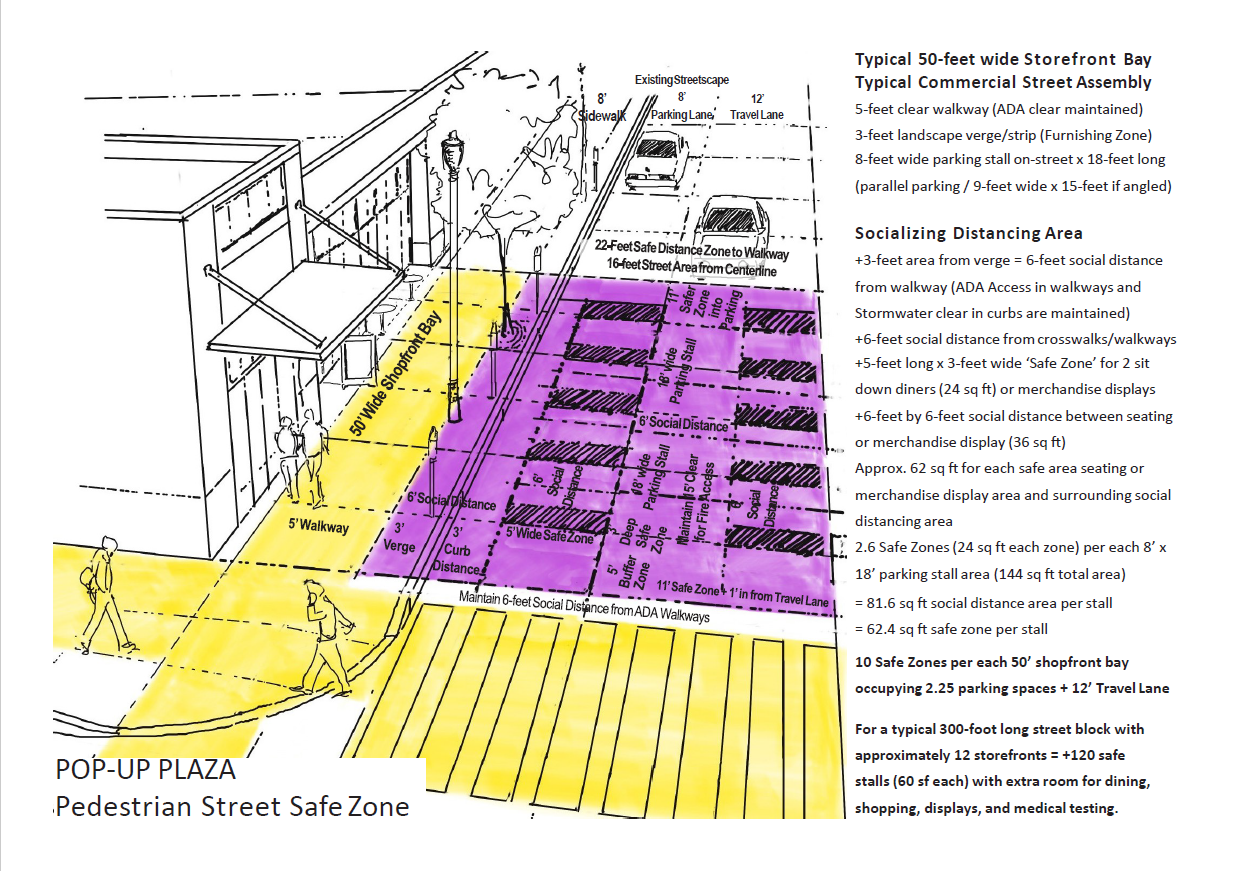
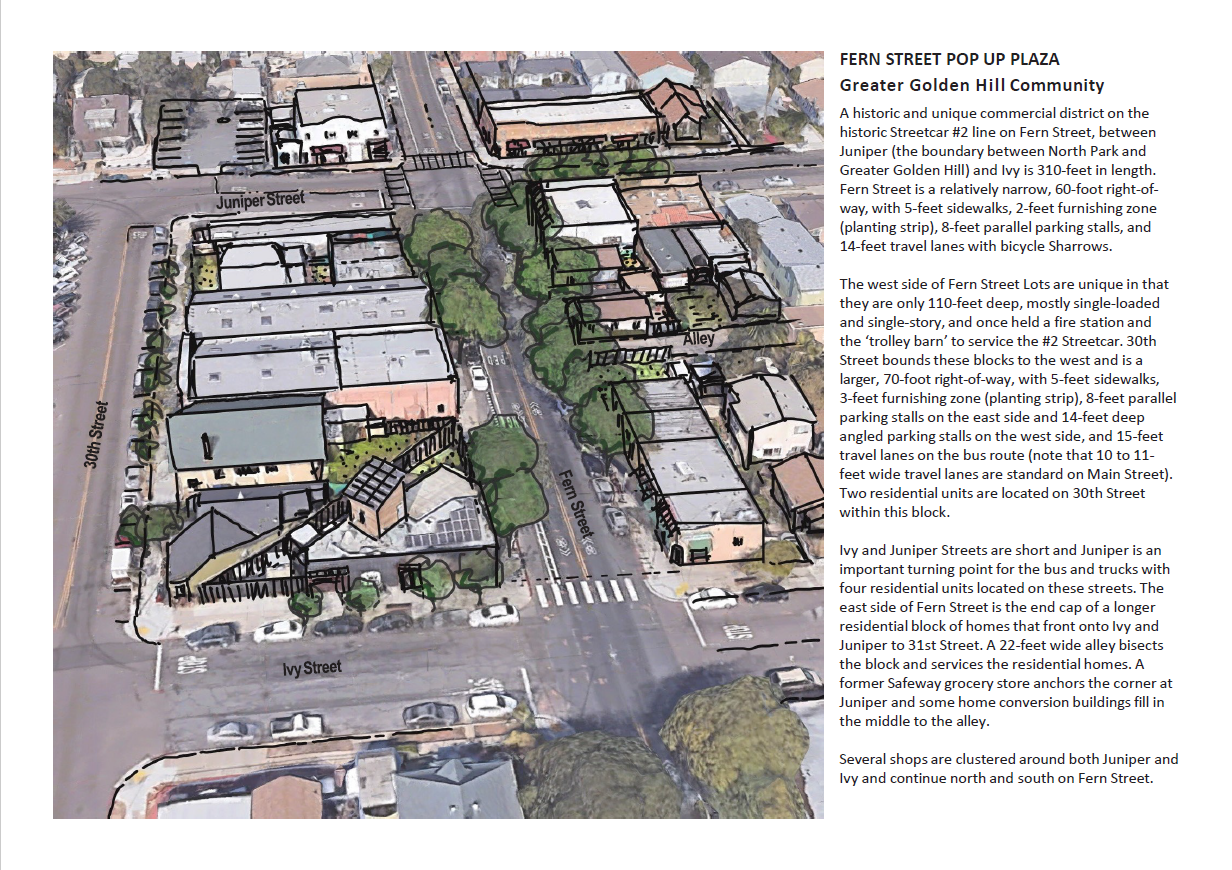
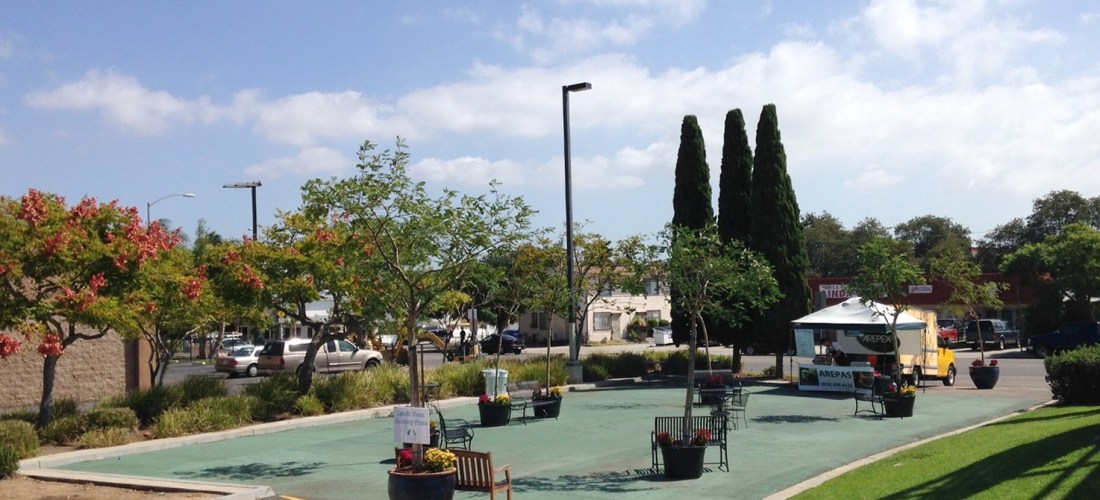
These illustrations and site plans are intended to assist our cities in enabling open-air markets in streets and rights-of-way. A follow up to the Podcast interview I had with Andrew Keatts this week (click here), the math shows that a full block provides the most area to enable more dining and shopping to be located in neighborhood centers located every half-mile or so apart. These ‘streateries’ would be managed and operated by local Business Improvement Districts (BIDs) and Main Street organizations in order to be equitable across the city without it being shop by shop and coordinate efforts and resources (money) to enable us to have a safe place to go to dine in/out, shop in/out, and communicate with others.

San Diego simply doesn’t have enough local parks and plazas to handle the excess space needed to bring small businesses back to our neighborhoods. These places are intended to help small businesses reopen, as well as provide more public space to safely re-emerge from our homes and back into our neighborhoods. These standards would mitigate for social distancing while allowing the local shops to expand their capacity with the biggest issues to be planned for are conflicts between cars and people and maintaining socializing distancing.

The state is beginning to allow shops and restaurants to reopen at 50% capacity and still offer take out service. These plazas are intended to provide that other 50% capacity to help these businesses. In these standard 3-feet by 5-feet ‘safe zones,’ surrounded by a 6-feet social distancing area, are able to comfortably provide a table with two chairs, or a merchandise display, clothing racks, and a place to sit and wait for food while enjoying beverages in the summer time. They’re a safe relief value from the past 3 months of quarantine.

Importantly, American Disabilities Act standards are maintained. Stormwater runoff at the curb is maintained. And, a 15-foot clear fire access lane is maintained through the center of the streetscape as these spaces are marked off by tape and paint. The traffic barriers and reflective tape/paint costs money by the BIDs and local municipalities. The maintenance, cleaning, and daily operation will be a public-private partnership with local shops being active participants in managing these new public spaces. The shops that front onto the space, as well as in the immediate surrounding area, are able to benefit from this extra area and enhance the experience with lighting, signage, shade, seating, and sounds.

The National Association of City Transportation Officials (@NACTO) has recently shared its open Streets for Pandemic Recovery design guidelines here. And, a favorite colleague,  Mike Lydon of @Streetplans, is leading a national Open Streets effort, which can be heard/seen here.

We rarely go out shopping and dining to stimulate the economy. The quality of these dining or shopping experiences will entice us to spend time and money because we go places for the experience. Opening streets to businesses involves a plan and design outcome that makes being there worth the time spent. I hope these are useful in starting that plan and beginning the design of our brave new world… outdoors!

Conservation of Culture Conversation

Public Space, San Diego, Urban Design

In the past, our culture (music, socializing, celebrations, food, worshipping) had secure foundations in public buildings, streets, squares and plazas (church, concert hall, theater, pub, halls, and markets), and in the private home.

Our parents added television, cars, the highway, and suburbia to these public and private places (drive-in theaters, drive-thru diners, freeway overpass protests, tv movies, tv evangelist, tv news, home theaters, homes cafes, home entertainment, backyard pools), shifting our culture towards a more private life.

Today, we are adding smart phone technology to these public and private spaces while shifting away from insular private suburban culture and towards a more balanced public and private life. These smart phones are our 21st century version of urban renewal, allowing us to re-inhabit and re-animate public buildings, streets, squares, and plazas cheaper, faster, and with more friends and family.

Within a century, everything has changed with how we share music, socialize, celebrate, eat, worship, and share our selfies with smartphone technology in our daily lives/culture. And, with this pandemic… it’s dramatically changing again. See you on the other side!

In reference to Roger Scruton’s article, https://www.futuresymphony.org/why-musicians-need-philosophy/

How to Enable Social Housing in San Diego

San Diego, Urban Planning

The Trouble with California’s Constitution Article 34

We Californians added a state constitutional requirement in 1950 for voter approval before the building of any public housing. Article 34 was passed then because the real estate industry argued that public housing is publicly funded infrastructure similar to schools or roads, and that taxpayers should have a right to vote on low-income housing projects. At that time, the campaign also stoked racist fears about integrating neighborhoods along with the McCarthy-era rhetoric about the need to combat socialism (sounds terribly familiar to our health care and higher education dialog today).

The Supreme Court of the United States upheld Article 34 in the early 1970s. And today, State Senator Ben Allen (D-Santa Monica) has introduced legislation to repeal the Article on the 2020 statewide ballot. San Diego is experiencing an acute housing crisis. The State is instructing cities to lower regulatory barriers to building Affordable Housing (AH), and San Diego has complied with some parking reductions, an AH incentive program, and other tools to assist private and non-profit developers to build more AH housing. However, all are encumbered by high land and labor costs with the majority of the savings on the cost of newly constructed buildings found in permitting and processing, which is a low percentage of the cost of housing.

Public housing built on public land is provides the cheapest delivery mechanism to build cheaper housing for people who cannot afford market rate housing. Bottom line, the land is the cheapest, the labor is well-negotiated, the outcomes are more predictable than using subsidies, waivers, and other regulatory tools to subsidize new construction. The City of San Diego needs to build 12,000 new units annually to keep up with demand (we might build half that on a good year), and we’re trying to double our production with one hand tied behind our back by only relying on private development transactions. We’re in a crisis and it’s time to untie the other hand.

HousingProductionSanDiego

The following are my recommendations for how our region’s cities, and City and County of San Diego can begin to build public housing:

  • Build local state governance representative support for Senator Allen’s bill to repeal Article 34 via Honorable Toni Atkins and Hon. Lorena Gonzalez. Because this will need political will from the Democratic/Labor left, public housing offers the incentive of more construction and management jobs and housing opportunities for trade workers.
  • Take the lead in proposing a statewide ballot proposition to repeal Article 34 by obtaining signatures from 8% of the registered voters who voted (12,464,235 total votes) in the most recent election for governor. This is impossible as we’d need 997,139 of signatures @ $6.20 per signature = $6,182,260.00!
  • Lead a local ballot measure to ask for a majority public vote on allowing the county and cities to build Low-Income (Subsidized) housing on City, County, Agency, and State lands. Initiated by either a petition signed by registered voters or via State Legislature such as Ms Gonzalez or Ms. Atkins, which again needs political will from the Democratic/Labor left, offering more trade jobs and housing opportunities for trade workers is the incentive for their support.
  • Build Middle Income, non-subsidized “Essential Workers” housing that is above the subsidized state-defined Moderate-Income Affordable Housing program, which is >120% AMI. Average Median Income (AMI) for all counties established by HUD is $64,800 for 2019, which is $77,760. San Diego’s annual median income is $76,662. Start building Median Income Housing for rent on City and County lands today betting that Article 34 will be repealed and you’ll have future AH housing stock available – This could be done in conjunction with a non-profit education platform to help local citizens strengthen their neighborhoods through small-scale real estate projects. The Incremental Development Workshop trains small-scaled developers to build capacity and value for locals to be education on how to use San Diego’s inherent land values (as owner/developers or trades/labor) to invest in their own neighborhoods, retain their stake in a neighborhoods, and raise values lot-by-lot without displacement. Importantly, this could be financed by allowing local municipalities to borrow against their assets and rental income in the same way as registered providers and the private sector.

A common fear over this method of delivering AH is the possibility of skewing the housing construction market’s ability to fill any new market demands/needs. Our construction costs today are going through the roof (and has historically) as the ability to attract and retain construction workers in an expensive housing market makes workers scarce. So, the concern about the potential pressure on the existing skilled labor force is very real and illustrates the need for cheaper housing in our region.

In other places with skill shortages, such as the UK and middle-America, they are turning to establishing factories to create homes using modern modular methods of construction.
The rise and fall of our housing market influences the amount of Inclusionary Housing fees collected, which exacerbates the one-hand-tied-behind-our-back conundrum. And to build a significant amount of AH, we need new housing starts funded by developers’ contributions and any reduction in these contributions has a considerable effect on the  availability of AH. As a capitalist society there are always uncertainties in the market related to finance, labor force to construct housing, professional skills and shifts in the proportions of dwellings in each of the 10 housing market types.

Here are the ten (10) types of housing markets in San Diego (and who is responsible for building each type):

  1. Low/Mid-Rise New Construction Housing for Sale (National, Regional, Local developers/builders);
  2. Low/Mid-Rise New Construction Housing for Rent (National, Regional, Local developers/builders);
  3. High-Rise New Construction Housing for Sale (National, Regional, Local developers/builders, Trades);
  4. High-Rise New Construction Housing for Rent (National, Regional, Local developers/builders, Trades);
  5. New Affordable Housing for Rent (Housing Commissions + Non-Profit AH Developers, Trades);
  6. New Special Needs/Workforce Housing (Housing Commissions + AH Non-Profit developers, Trades)
  7. Existing Special Needs/Workforce housing (Housing Commissions + AH Non-Profit developers, Trades)
  8. Existing Housing Stock for Sale (Investors/Homeowners);
  9. Existing Housing Stock for Rent (Investors/Homeowners)
  10. New Custom and Self-Built Housing (Investors/Homeowners).

There are two (2) additional types of housing missing in San Diego that are available to other human beings in other parts of the world:

  1. Social Housing for Sale (Agencies, Housing Commissions + Trades);
  2. Social Housing for Rent (Agencies, Housing Commissions + Trades).

A hard truth is that our well-trained construction trades limit worker availability capacity (scarcity) that drives up construction costs. Another hard truth is that cheaper labor doesn’t offer the same level of quality . Affordable Housing built in private low to mid-rise development mostly excludes Trades Labor. And, Trades are used for all high-rise development, for rent or for sale, because of the expert skills needed to construction tall buildings. And, the trades-only construction scenario for AH/Special needs housing is detrimental to the cost of construction but imperative to the political will to build it. In my opinion, this illustrated clearly the failure of capitalism.

The need for more construction workers is real. The need for housing to house new construction workers to live in is a chicken/egg conundrum San Diego has had to deal with for a century. And, it is a common insistence from the development industry that the nation is suffering from a labor shortage.

So, the best solution is to cultivate a local construction trade industry, rather than hope to poach workers from other cities. San Diego City College has a trade apprenticeship program that a national developer is working with to building their own General Contracting company to build a new project in San Diego. This is the future of construction.

These are my recommendations to deal with the labor market via private corporate leadership (Chamber, Trades, Economic Development Corporation’s role):

  • Build up skills to support housing delivery including labor trades, capital program accountants, legal and structural engineers as well planners and surveyors;
  • Assume that some housing will need to be provided with direct involvement of local municipality;
  • Recognize that corporate leadership is central to success in housing delivery;
  • Recognize the role of local industrial strategies in supporting local housing needs for a full range of dwelling types that can house people who can support the local and regional economy.

These are my recommendations to enable social housing in local municipalities:

  • Understand the Cities, County, and Agencies have different buckets of money to access and land taxation rules than neighboring cities;
  • Recognize in housing finance policy that the number and mix of homes required in San Diego over the next forty years cannot be provided entirely by private sector funding;
  • Consider the role of the municipality as a patient investor in its area;
  • Consider providing all 12 types of housing that might be required for local needs if this is not being met by other providers;
  • Establish a housing and planning delivery team to manage the implementation of all housing plans regardless of public or private proponent;
  • Establish a housing delivery board to monitor progress and delivery;
  • Establish a housing delivery forum of all providers in the area to meet regularly to discuss progress and problems;
  • Establish a housing intervention fund to help overcome issues on individual sites (funding can be made as a grant, a loan or in return for development equity);
  • Promote how housing supports the local economic objectives (e.g. retention of younger professionals and graduates living in and moving to the area);
  • Assess all sites in municipality ownership for housing suitability;
  • Include more detailed housing delivery outcomes in SANDAG’s annual monitoring report;
  • Consider purchasing land for housing as an investment for the longer term;
  • Work in conjunction with non-profit education platforms, such as local Labor/Trades Unions, LISC, and NeighborWorks, to trains locals construction trades and how to be small-scaled developers to build capacity and value for locals to be education on how to use San Diego’s inherent land values (as owner/developers or trades/labor) to invest in their own neighborhood through small-scale real estate projects. The Incremental Development Workshops encourages locals to retain their stake in a neighborhoods, and raise values lot-by-lot without displacement or outside forced gentrification, and;
  • Establish a funding subsidy program through grants for local authority direct delivery of housing and other mechanisms such as by bonding or the general fund.

I have in my hand a list of 135 known socialized housing projects throughout Vienna that prove this is a viable tool to addressing San Diego’s housing crisis. Thanks to Voice of San Diego and Unsplash for the graphics, and political consultant Andy Kopp for the inspiration.