Leon Krier was Right

Leon Krier, philosophy, Urban Design

My most significant educational experience was sitting directly across from Leon on a 5-day charrette in Chico, California, 22 years ago. The intense time spent with him changed the trajectory of my professional life… because Leon Krier was right.

Ye shall know the truth, and the truth shall set you free.” – Jesus

Leon was a man of great character, who was the largest influencer of my education, as far as any single person could have affected it. Another iconic person (of whom I can never repay for their professional generosity and genius), Andres Duany, wrote this loving eulogy that correctly identifies the voracious and tenacious conviction of Krier’s work in contrast to Leon’s gracious, admirable, and courteous lifestyle. His life’s story is well documented. His uniquely lived experience of growing up in Post-WWII reconstruction Luxembourg, combined with his informal education (he learned from mentors and teaching at London’s Architects Association) as processed through his complex character (see Duany’s description above) shaped his incredible creativity.

Leon correctly identified that industrialization had devastated our civilization and its buildings and cities. Krier was the first to challenge the modernist dogma in the 70s as young architect. Because of his lone advocacy turning into a movement, today we have a fuller spectrum of design choices, from self-referential modernism to traditional vernacular to classically ordered tools. Leon Krier was right.

A few years ago, upon picking him up from the airport, I immediately drove Leon to share my disdain of the latest modernist infill project in my turn-of-the-century streetcar neighborhood. It’s a copy of Corbu’s Villa Savoye that had been in Architecture Record. I was fully expecting an affirmation of my disgust when Leon surprising said, “It’s good.” My eyes widened and my hands gesticulated wildly as I explained that the building’s fenestration was backwards, completely ignored its context, and the urbanism only existent in materials and scale. Leon agreed that while all I said was true, for a modernist building it was a very good example.

The lesson being, “If you are going to do modernism (or anything for that matter)… then do it well.”

I had forgotten how difficult it is to get any building or nice place built. My New Urbanist dogma had gotten in the way of this human truth. He said that to build anything in today’s toxic environment (naturally and politically) was laudable and then to build it well was meaningful. Leon Krier was right.

I am fortunate to have spent days and hours talking with Leon while driving across US west deserts, working in San Diego, and online during Covid. While his professional works is polemic and absolute, his personal perspective was equally optimistic and positive. Another grand lesson I learned from Leon on the importance of what we do was that, “The architecture the city and public spaces is a matter of common concern to the same degree as laws and language; they are the foundation of civility and civilization.

It was a feast to have learned these truths from my genial mentor. Thank you again, Leon.

[This week my lovely daughter in London posted this in front of the Architectural Association]

Justin Shubow

Trading the Big Idea for One Building

Leon Krier, Public Space, Urban Design

President of the National Civic Art Society, a non-profit organization headquartered in Washington, D.C. that promotes the classical and humanistic tradition in public art and architecture, Justin Shubow is an architectural enigma to me. Obviously partisan, which I am admittedly too, his appearance on Ben Shapiro’s show demonstrates how his ideas for classical architecture are ascending again in Trump’s 2nd term. However, I see Trump as a criminal. That said, I supported Justin’s approach to the Eisenhower Memorial prior to Trump, so I have to check myself before I say too much, which is not my strongest trait.

As Leon Krier points out in his book on Albert Speer… Even criminals can make great architecture. Krier illustrates how Speer used classical architecture in support of his totalitarian regime by blowing it up to an industrial/modern megalomania scale. Today, the worst developer in NYC can support beautiful architecture despite his criminal intent as President. Right now, Trump is restructuring our government into partisan loyalist, which should be opposed rather than being complicit with. As much as I support classical and traditional architecture, I cannot enable Trump’s evil intentions in exchange for building a better FBI building. 

The basis of my criticism is that the FBI building is a one-off anecdotal, microcosm (DC) to the larger macro (USA) issue of how the General Services Administration (GSA) process that eliminates the ability for classical architecture to compete for new projects. Both are a problem. But I believe if we fix the macro problem we can influence how the micro is rebuilt in the future. My perspective is shaped by my membership with the GSA Design Excellence Peer Review Committee, which Trump is already reshaping into his image. 

Therefore, I suggest we advocate for our long-standing democratic processes to reform GSA and how we rebuild Federal buildings in the future for all rather than bow to a tyrant to get what we want today. It’s not worth the trade, IMHO.

We’ve Lost that Loving Feeling.

Urban Design, Urban Planning

From Rick Cole’s article in Southern Urbanism: “In this sense, the enemy is… placeless sprawl. These are locations that have no distinct character, no history, and no beauty, that typically fulfill just a single function. We park there, we work there, we reside there, we shop there, we drive through there. But beyond those necessary functions, the bleak landscapes of sprawl lack a shared and diverse public realm. Without such a public realm, community dissolves into private space. Shared space gives room for different people engaged in varied activities. That is the physical manifestation of community—and the physical setting for community, too. Community can happen in a park, in and around a neighborhood store, on a crowded sidewalk, or in any other public gathering space. The ties of community can be tight—among neighbors at a farmers’ market, for example. They can also be loose—such as among strangers at a transit stop. Whatever those ties look like, a robust public realm is vital to generating a shared sense of community.

It is precisely this shared sense of community that is breaking down all across North America. Sprawling suburbs and walled-off, self-contained urban “projects” deprive us of a place for community to grow. Evolving technologies accelerate our detachment from real life, happening in real places. Human beings crave belonging, so in the absence of a shared community, we gravitate toward self-selected faux-communities that more resemble tribes. Unlike citizens of a true community, these factions have no commitment to their neighbors or loyalty to the places they happen to occupy. When we are rigidly separated by income, race, and lifestyles, the fragile shared bonds of a democratic society inevitably fray into “us” versus “them.”

And from Jeff Wood’s Overhead Wire: “Of course most stores can’t compete with Amazon or Walmart he said, but what they can do is create a better shopping experience and pleasant environment people want to visit. This redevelopment can’t be just another (strip center, suburban mall, or) office park, it should be a destination in its own right if it is to succeed.”

Places we love and want to spend time are valuable for many reasons… economically, socially, and environmentally, because we care for and maintain those spaces, and fill them with people and trees rather than laying down asphalt and putting up a butler building on that next offramp further outside of town. Therefore, better places are more sustainable than crappy suburban ones.

How do You See the City?

Urban Design, Urban Planning

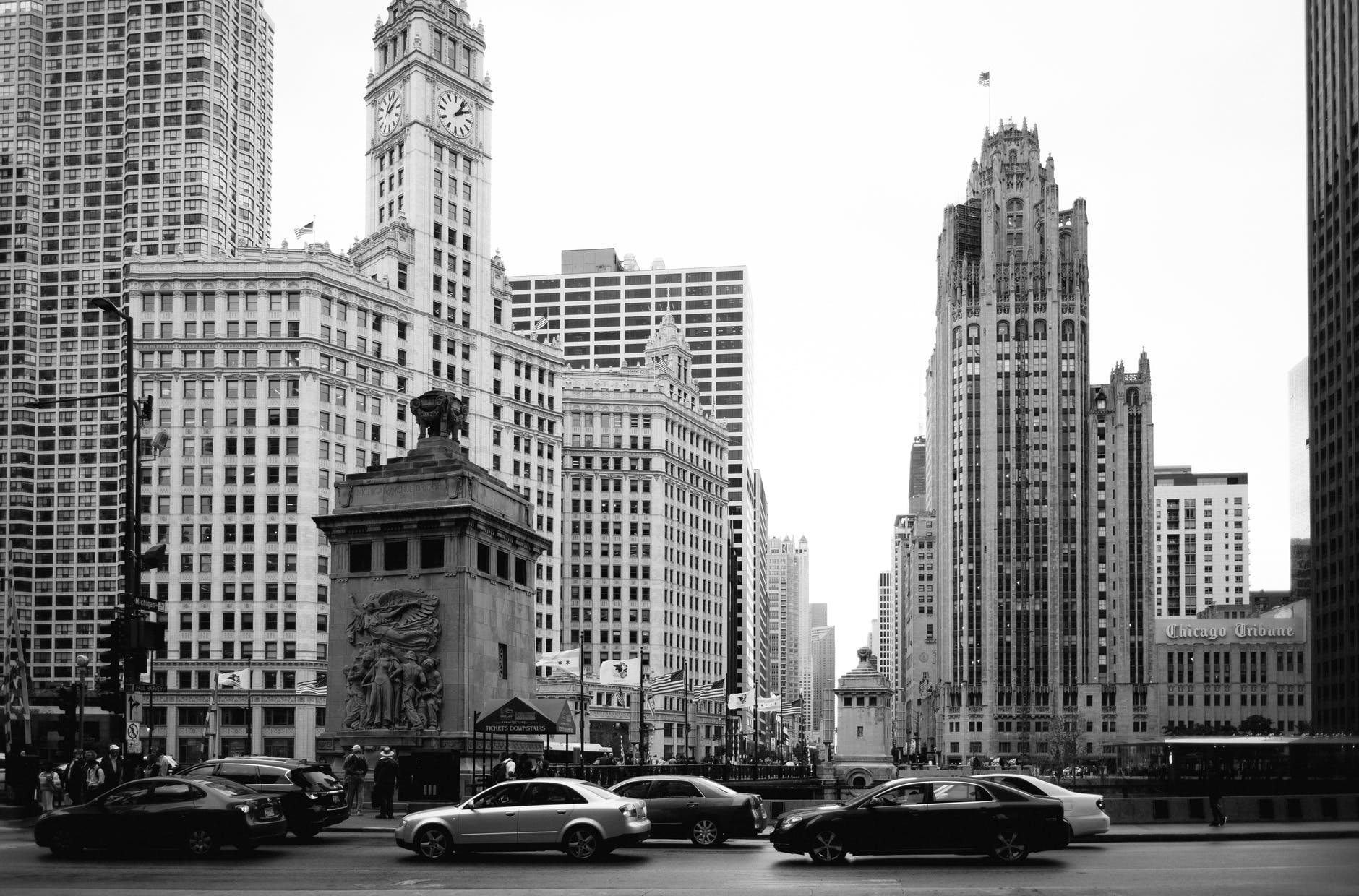
I see every city for how it was built when it got rich. Economies move around, cities rise, fall, and some rise again, reinvent themselves, die off, or sit stagnate waiting for its revival. But, at some point every major city got really rich, and that’s when its public streets, parks, buildings, and private buildings set the bar/tone for the next century or so.

grayscale photo of high rise buildings

Photo by Ross Richardson on Pexels.com

For example, in San Diego, it got rich in the early 1950’s, when its population double as military R&D rose/located near its military installations. High wages, lots of jobs, and land for suburban growth with great state/fed spending on highways and our pending car culture. Spending its money during our mid-century modernist era has formed/shaped the context for the city of today and beyond.

It was a trip to Buffalo, and seeing its turn of the century opulence, that showed me how to ‘see’ a city.  Every great American architect of that time, Frank Lloyd Wright, Louis Sullivan, Frederick Law Olmsted, were building in Buffalo at that time and it generated two Presidents. This view translates to seeing our old European cities, such as Venice and its well-preserved mid-millennium opulence still valuable today, as well as in seeing our Asian cities, such as ShenZhen and its booming wealth (with every architect in the world, Steven Holl, BIG, and Gensler working there), and so on…

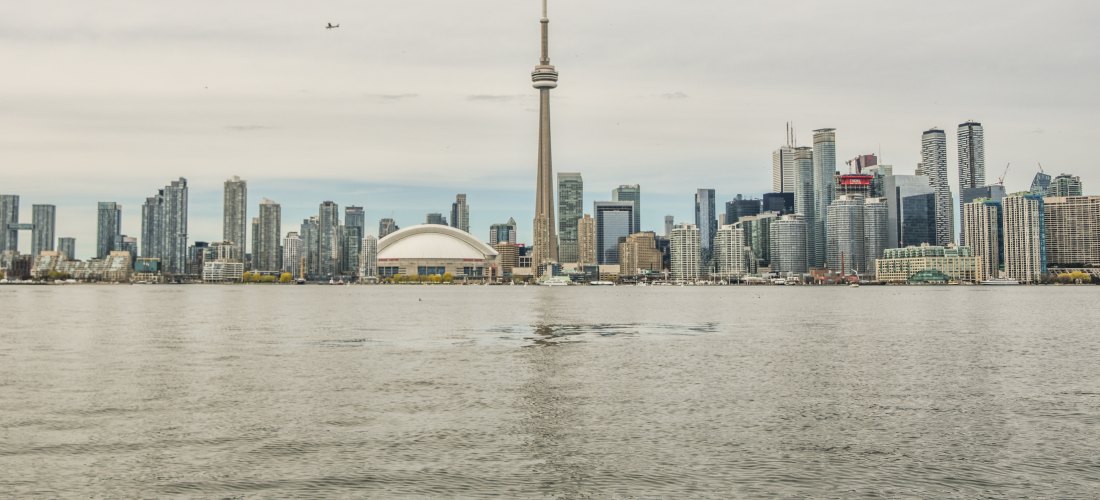
Vancouver got rich as Hong Kong shifted hands from English to Chinese rule 20+ years ago. That era’s neo-conservative ‘free market’ architectural expression of almost urban, but not quite, townhouse wrap of a small footprint, single-core tower was urbanism-lite at time when suburbia ruled our west coast north American landscape. And, it was the right architectural form for transitioning from suburbia back to urbanism… but, its already dated and in transition again, and towards a more urban pattern.

assorted labeled signage

Photo by Arnie Chou on Pexels.com

This new era is beholden to the ‘got really rich’ era in Vancouver and will still be subservient to that context, which wasn’t true 20+ years earlier when that great flush of wealth easily overwhelmed its past and context. Meaning, the wealth generated today in Vancouver is simply the by-product of yesterday’s economic boom. Same with Venice and its tourist value today for preserving its past opulence.

We’re watching the political anxiety in the face of this urban shift playing out across the world as the last throes of that 80/90s neocon intellectual culture are desperately holding on to the last of their structured power. Those  neocons who are voraciously holding onto power today also hold the counterculture of the 1960s in great disdain as their political radicalism and animus against authority, custom, and tradition is rising and an obvious threat to the old leaders. I believe this disdain is one of the reasons for the angry, resentful, punitive political furry expressed in Washington, DC and beyond… because the neo-counterculture is being repeated by today’s younger generation but this time with their own value system/context.

The millennials are choosing to spend their money in cities that are getting rich right now. These are San Jose, Oklahoma City, and in rebound cities, such as Austin, Seattle, and maybe Detroit (an anomaly in this group of relatively ‘new’ towns as it got very rich in the 1940s and may keep its Art-Deco patterns) will be reshaped with their values. I’m looking forward to ‘seeing’ how these cities express themselves as they grow rich over the next decade (with Vancouver’s ubiquitous point towers with a townhouse wrap in mind).

A Vertical Transect / Context Elevated

Urban Design

I’ve been fussing around with a context-sensitive/form-based code for more urban neighborhoods for several years now. I’ve worked on creating many codes for small towns (San Marcos, CA and TX), new towns (Whitehall in New Castle County, Delaware), sections of mid-sized cities (El Paso) across the county, and downtown San Diego. And, it’s here in San Diego that I see the need to craft a code for tall buildings that better reflects our 21st century context.

Over a century ago, Louis Sullivan, HH Richardson and others rebuilt Chicago after its fire using the new construction technology that steel brought to building. That combination of steel and fire led to the creation of the tower as a new building type. Being without precedent then, these neo-classical, romanesque, and gothic revivalist smartly relied upon the classical column structure to design towers with a base, shaft, and cornice.

TopMiddleBase

Base/Base, Shaft/Middle, Top/Cornice. 

Today this classical configuration still seen in the now ubiquitous Vancouver Point Tower Model.

SD Vancouver Model

The Vancouver Point Tower as Applied in San Diego. Image: Me

Today, after 100-plus years of building these classically arranged towers a vertical context exist. And, we’ve worked very hard since the 60’s modernist crescendo to get tower construction at the street level to be humane (see this old blog on the topic).  I first got the idea from Jan Gehl’s book, Cities for People, and these great diagrams.

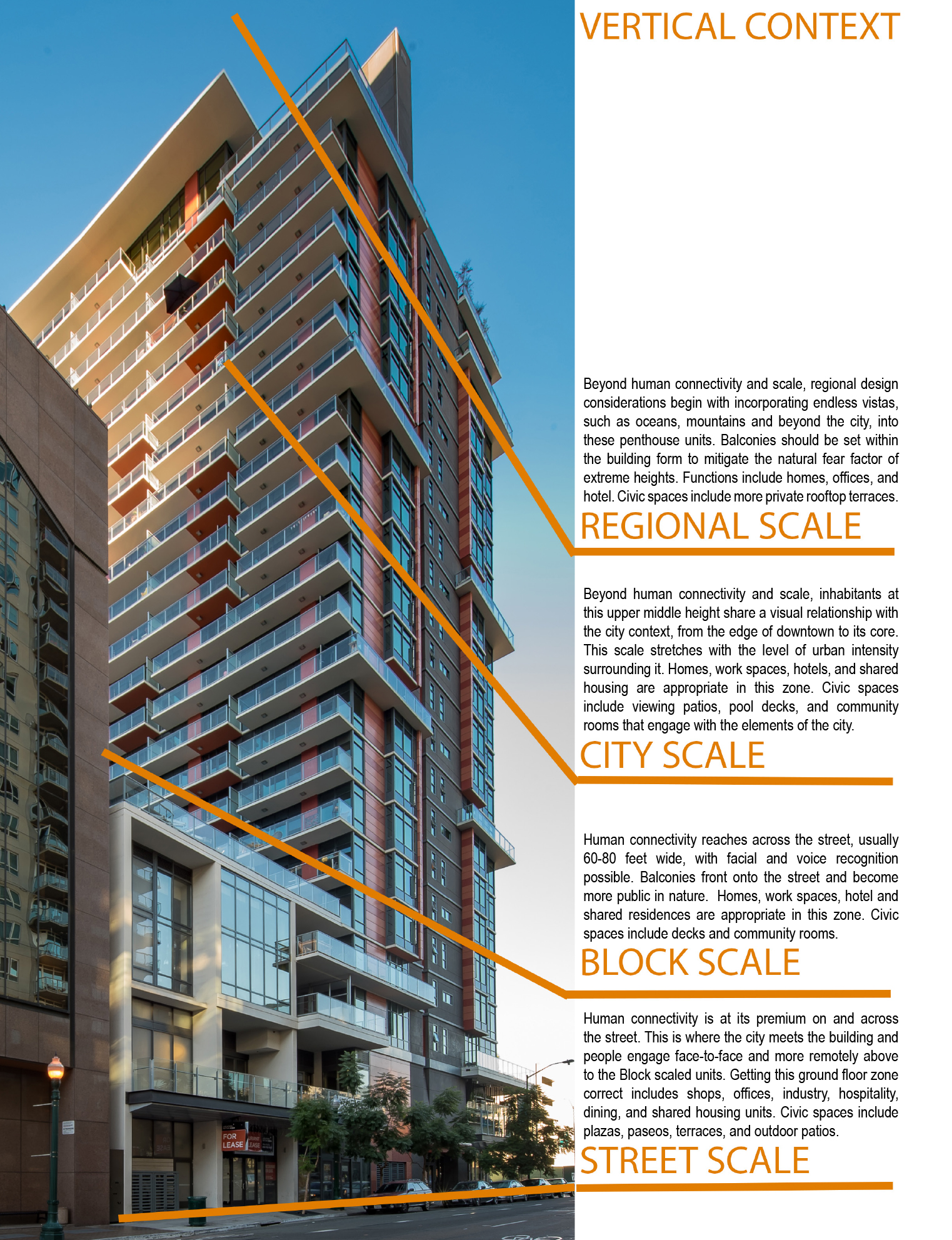
This new context is based on the following transect zones: Human connectivity is the primary objective in the street zone (floors 1 – 6), which transitions up to the facing blocks (floors 3 – 12), up again towards the surrounding city views levels (floors 9 – 20), and finally at the regional vistas (above 20 floors). These four context zones have differing design responses to consider as the now the building can reach down toward street rather than always soaring to the sky.


VerticalContext_2

As applied to a Vancouver Point Tower in downtown San Diego. Image: Me

The following diagram was an initial study into how to use the SmartCode template to regulate more urban buildings where their fronts/back, below/above, and middle zones could be designed in context to cultivate urban living that is human oriented rather than mechanical elevator-oriented. What do you think?

3D Urbanism 1st Draft

Borrowing from the SmartCode, a Context-Sensitive Code for 3-Dimensional Urbanism

And, we are continuing to study this approach that lends itself to coding for a specific San Diego model and moves beyond the Vancouver point-tower lite urban model.

VerticalContextIMAGES

Precedent Images Attempting to Define a San Diego Architectural Vernacular for Towers

And, finally, just because I drew it… here’s another inspiration for getting towers’ grounded into its context, a metaphor if you will.

TowerMetaphor

I drew it so I put in my blog… otherwise it’s not much to look at. Image: Me

I would appreciate any comments as this is an idea that’s still under construction. Cheers!