Leonardo Divinci's City Plan, "BE COOL."

The #1 Reason for Zoning Reform: People are Obnoxious

Uncategorized

Missing middle housing, and similar ideas of gentle density and incremental housing, are useful tools for cities allow for new homes to be built in existing neighborhoods. This is especially true for older or historic neighborhoods with predominantly low scale, low density, single-family detached homes. These are measured tools that transition long-standing neighborhoods from no-growth to adding more middle/medium scale housing/density/population. These new apartments/attached buildings adds a variety of people at different socioeconomic points of their lives, which smaller and larger units on the same neighborhood block tend to do. And new infill homes add tax revenues to fix old streets, sidewalks, lights, parks, and other civic infrastructure (in concept).

Fortunately the City San Diego’s planning department is starting to reform its zoning. It recently identified and adopted Transit Priority and Sustainable Development Areas. These allow for new projects that include affordable housing to waive its zoning, such as height, setbacks, and density. This is a very smart understanding that our city’s conventional zoning, the rules that regulate the configuration and orientation of a building, are out-of-date and not aligned with today’s housing-at-all-cost priorities. This is a great first step in recognizing that conventional zoning is broken. And for the past decade our state legislature has been pushing cities to allow for more housing and bypass its long-standing zoning rules, which have been rightfully deemed as being in the way of building cheaper, faster housing.

Born from racism and modernism in response to the industrial age, conventional planning and zoning is just a dumb form of segregation by land use. Residential, commercial, and industrial use separation has wasted our time (too many hearings, decision-makers, and gatekeepers), space (suburbia as far as the eye can see), and money (housing scarcity and prices). It is has been in need of reform for decades, but status quo is difficult to change, as well as messing with people’s inherent land values.

As a New Urbanist, I’ve been advocating for Form-Based Codes as code reform for over 25 years. These emphasize the configuration of buildings and places in context and/or form first, such as Main Street buildings on Main Street and rural buildings in rural areas. The function, or land use, of a building and its surroundings, are of a lower priority in Form-Based Codes as mixed-use, walkable urbanism is more complex than making us drive to a pod of work/home/play/shop/worship suburbanism. It is a proactive, rather than restrictive, approach to zoning regulations. And Form-Based Codes (now Objective Design Standards in California) are reforming zoning across the nation, albeit slowly.

Thankfully, the New Urbanism has won the war against suburbia. New housing is mostly in town or extending the town’s boundary on its edge. Rarely do we build new stand-alone subdivisions out by the wastewater plant, over ancient graves, or adjacent to heavy industrial districts, which is a good thing as those are noxious and dangerous places. Today these noxious districts are regulated by State or Federal rules and not local municipal zoning anymore. However, the new Federal administration is pulling the plug on these regulators, so…

Wiser, I see that new housing isn’t being located near those old toxic/noxious places, such as iron smelting or horse melting to make glue – as those industries are now done in other countries – because new homes are mostly being built next to existing homes. This means new housing problems are how their presence creates friction between both new neighbors and with existing residents. In short, as much as we love people and each other… we also really don’t like each other just as much. We live in a world wanting peace and quiet, and rules to keep it that way (see: every religion).

As humans, we understand that we have more public fronts/faces, sides, and more private rears/backyards. We prefer people, that aren’t immediate family, to either face us along a more formal public street or back onto each other with private space/yard or messy service alley. We’re built this way. It is well understood, comfortable, stable, and peaceful. Especially when we respect our western cultural social and physical norms. Bravo’s housewives, “Be cool, don’t be like all uncool,” would probably be a great zoning reform policy.

We also want justice. And when someone else appears to be getting ‘more’ than ourselves or others, it creates a sense of injustice. When one neighbor places a 3x taller building next to low-rise homes, it confuses the home’s fronts and backs as well as land values, which are destabilized with extreme building types sitting adjacent to each other. It creates fiction and conflict between people, not the land uses.

Without building zoning standards, public fronts and private backs are confused. Where are we supposed to be loud, welcome guests at the front door, throw our trash, sit quietly, and put screaming kids to play? Being cool is more than a suggestion… it’s in need of new rules.

Zoning today equates to almost exclusively dealing with obnoxiousness between residents, such front doors looming over backyards and quiet places versus public engagement places. These aren’t noxious issues, such as industry pollution spoiling the land, but more offensive social issues that spoil our previously suburban quality of life (more on that in a later blog), as the want for quiet and dogs/pets in downtowns are a “suburban echo,” and a new expectation for living in urban neighborhoods. Zoning reform needs to focus on these very real issues. The absences of rules only creates unintended conflicts between neighbors.

We need to set boundaries on how to live together. Meaning, we need new zoning rules for obnoxious behaviors rather than 1940 rules for noxious conditions. Sociable neighborhoods start with putting the right range of building types on specific street types with specific park types that help our society get along well. Missing middle housing types are better than towers to fill in older neighborhoods. They create less conflicts while adding lighter, faster, and cheaper homes.

These are simple rules that can be monitored by city (public) planning and development departments while it works towards building better public streets, sidewalks, lights, and parks (public entities doing public stuff), while regulating the simple stuff that we know lends itself to obnoxious behaviors between private developments. Following any good planning strategy, zoning reform starts with understanding today’s context, collaborating to generate a common Vision (making policies that relate to our values and priorities today), then generating a plan and/or code (making regulations), and then making them happen through actions and implement is how we implement zoning reform today. Be cool.

Housing for 1 Million New New Yorkers

Social Justice, Transit, Urban Design, Urban Planning

Last week, Vishaan Chakrabarti, founder of PAU, unveiled his firm’s housing analysis via The New York Times. The PAU founder says there is space for up to 520,245 homes in the city on roughly 1,700 acres of unused land. Most of it would be enacted above existing single-story commercial spaces.”

The article I read about the proposal, here, said they used, “available data on vacant lots, flood-prone areas, and the location of subway stations and other mass transit options.”

Uhm, well, okay… As stated in my previous two posts, that after 30+ years of illustrating the benefits of mixed-use, walkable, infill, transit-supported design, planning, architecture, and building, why are we still trying to sell the obvious? The NYT article references how infill is still controversial… based on Boomer NIMBY-ism. Or the lack of political courage to do what is right over the long-term.

Today it is an incredibly hard lift to get short-term politicians to address long-term issues against perceived short-term public interests, such as homeless on the streets (regional issue), interest rate fluctuations (national issue), and gas prices (international issues).

California’s housing crisis became a political crisis due to the technological advancement of social media to organize and coordinate a series of disparate Bay Area groups into one large YIMBY movement.  ‘Yes in My Backyard,’ led by Sonja Trauss, shifted San Francisco’s political approach to its acute housing and homelessness crisis to make these issues the city’s number one issues, beyond potholes and loss of parking spaces. The political structure of San Francisco, Oakland, San Jose, Sacramento, Los Angeles, Seattle, Portland, and San Diego followed in suit.

Social justice is today’s environmental movement of the 60s/70s, and economics in the 80s-00s. The third element of sustainability, we are learning how to build a more accessible and socially equitable city, which is why bicycles, walkability, shared mobility, complete streets, and transit-orientation are the focus of city making today. This housing crisis is a linchpin of the equity issue and I believe social equity/justice is a political crisis leaders must address. State laws are providing political cover for elected officials to pass new rules necessary to build more housing.

Lessons learned from SF’s YIMBYs to create a political crisis that makes change are:

– Organize various groups into one single-purpose, general issue group (with a catchy name)

    – Use new technology (social media expanded during their rise)

      – Put a charismatic leader with excellent public-speaking skills in front of the organization.

      – Provide political cover for our risk-adverse Mayor(s) to approve controversial housing projects.

      – Find and maintain the support of philanthropist.

      – Find and support like-minded candidates running for office on this project.

      – Sponsored policies dedicated to housing.

      – Educate citizens via various media to show how plans can turn into better projects. Provide reasonable tradeoff scenarios to educate everyday citizens. 

      To make this more citizen specific, this aligns with 5 Reasons People Accept Change (borrowed from reasons why people buy retail products):

      – Solves my pain – Homelessness is San Diego’s greatest pain.

      – This connects me to community – Everybody loves San Diego.

      – This makes my life easier – Able to conveniently access and enjoy beautiful spaces and places

      – This feels luxurious – San Diego is as beautiful as any place in the world, accessible to everyone.

      – This will make me more money – Our city can attract the World who’ll spend their money here.

      The following are ways to shift our cultural expectations necessary to change status quo, which takes time:

      Forces Within your Society: Homelessness is first. And then there are local advocacy groups or local connector/influencer people to collaborate with and an opportunity for coalition and capital building.

      Forces Between Societies: Regarding housing, State Law is the agent of change.

      Changes in our Natural Environment: Increased housing creates the need for high-quality amenity spaces. And climate change with longer, hotter, drier summers and wildfires are the low hanging fruit and take change out of our hands.

      Invention/Stimulus Diffusion: The new-new is faster smartphone technology, which is changing how we get around our cities with shared mobility and on-demand. Millennial culture ideas are making changes via smartphone technology inventions.

      Agents of Change. The best singular agents of change, are people who are culturally allowed to propose, advocate for, and succeed in making change are the following:

      Students/Faculty: Schools are teaching the future and past, but not status quo.

      Attorneys: Their job is manipulating the law and regulations.

      Designers/Artists: All projects are new and therefore represent change.

      Wealthy: Philanthropists are champions.

      Advocacy Groups: But they lack any authority.

      Long-Term Politicians: We have few in San Diego.

      Not Agents of Change. The least acceptable, singular agents of change, people not in the cultural expectations position to propose such and will eventually be your foil are:

      Chamber business interest/developers: Constituency groups that are risk adverse to change.

      Government Departments/Staff: They’re trying to equitable to all citizens, as change = winners/losers, and they’re not paid to make change.

      Churches / Religions: Maintain status quo.

      Community/Preservation Groups: Maintain status quo.

      Impoverished: Don’t experiment on the poor, they don’t have the resources to sustain failure.

      Short-Term Politicians: Our city council, Mayor, and County Supervisors.

      Politicians need that city-wide vision/principles/image to assist them in navigating the dichotomy of individual/small group fears versus larger city/common interests that this singular new project brings the city. And infill that builds mixed-use, walkable, transit-supported urbanism is our best sustainability tool.

      The State of Land Policy in America

      Uncategorized

      Recently, the Lincoln Institute asked readers to submit their best definitions of land policy. Being late, I offer the following that builds upon their submissions for your consideration:

      Land policy is the rules and regulations that govern the use, ownership, and management of urban and rural lands. It involves both rational and emotional decisions about how the federal, state, and local authorities determine land uses, who are allowed to access to it, and what activities are permitted on it. These policies trend with our collective social consciousness between individual property rights and common public good at both national and local levels.

      Land policy has both formal and informal outputs. Formal outputs are often plans, regulations, and programs. Informal outputs are often socially accepted patterns that shape our underlying cultural behaviors and social expectations. However, as stated in my previous blog, the federal, state, local land use policies are as misaligned as our current social and cultural malaise.

      The study of land policy was founded during the early 20th century’s Progressive Era in response to economically and environmental instability generated by industrialization’s overwhelming amount of poverty and pollution. The rising tide of the new industrial age/era wealth was expected to lift all ships, but apparently only the steel hulled ones stayed afloat. As JP Morgan, Carnegie, and Vanderbilt’s robber baron class drove our lassiez-faire economic policies towards violent race and class warfare during in the Reconstruction Era that led to the reactionary, government led Progressive Era.

      Land policies led to the establishment of local zoning controls in the 1930s/40’s. Then in the 50s/60s it was focused on urban renewal, and then environmental conservation in 60s/70s. In the 80s/90s it concentrated on redevelopment and economics. In our 21st century, it is focused on housing and social equity as our economy has again dramatically shifted, from industry to knowledge-based products.

      And so here we are again today, wrestling with lassiez-faire Republicans supported by capitalist oligarchs’ whose exploitative practices influence our highest levels of government policies and manipulate our media markets. They form monopolies to raise prices, pay subsistence wages, and exert control over natural and public resources to amass extraordinary wealth. And our current Democratic-led social justice and equity era is echoing the Progressive Era’s renegotiation of social norms in the face of violent white, Christian nationalism… Ugh.

      The GOP-led oligarchy system is being confused for authoritarianism. They’re not taking control; they’re abandoning the role of the government owning and managing the public good in trade for individual wealth creation. This is the state of Land Policy today…. the waiving of housing regulations while blocking the reformation of public housing to promote a supplyside, trickle-down response to chronic coastal city housing shortages. The focus on enabling regulatory-free development in transit areas policies without investing in transit supported infrastructure. And in economically static rust belt cities, nonprofits are expected to fill the void and role of both private development and public investments… Gah!

      We’re experiencing a new land policy era in real time. North American cities continue to transition towards more human-scale urban development patterns in our post-industrial society, and even more rapidly post-pandemic. And our land policy should be leading cities and neighborhoods towards economic, environmental, and social equilibrium and away from the predominantly individual interests over our collective needs… C’mon.

      “Are we there yet?” No… But we’re close.

      Economics

      I shared this very good 2013 documentary with a potential client in Fresno, California. And he asked after watching it if I thought Fresno was better off today from the ideas and potential presented a decade ago? I know Fresno is better off today than it was 10+ years ago because of its public and private investments highlighted in the movie. And it was a real change to restart the building of urbanism in a decades long suburban culture.

      Usually, this is when I self-righteously plow into the value of the New Urbanism and how 30 years ago we restarted and sustained this urban living revolution (with help from the sitcom, Friends). But it’s been 30 years, a full generation. And we should be fully building mixed-use, walkable, transit-supported urbanism at an industrial scale/speed by now, if measure by how long it took for the idea of suburbia to become reality. For example, Corbusier published the City of To-Morrow And Its Planning in 1929 and auto-oriented sprawl was in full bloom by 1959.

      Calthorpe, Duany, and Katz all published their groundbreaking books on the New Urbanism in the early 1990s and here we are in 2023. Why aren’t we there yet? We’re most certainly moving in that direction, but too slowly.

      That said, every city’s revitalization efforts suffered setbacks from the dramatic changes to how we work and commute due to the Covid shutdown. In California, we’re not building offices, retail is dead, and housing is king, because we’re building so little of it and we’re now working and shopping from home. I think that our Covid reset has to be overcome by all American cities, especially Fresno.

      The overall development and construction industry in California appears to be in a static point between the pendulum swings of change, from suburban to urban building. And no major city in California is building enough housing to meet its market demands beyond the few thousand or so built a year on the fringes in master planned communities by the few big home building firms leftover from the 80s.

      We have zero national or regional building/construction companies that build urban infill housing types at an industrial scale. We depend on 1,000 small-scale builders in every city to build enough housing to meet market demands, who are all learning and starting from scratch at the same time. Few are trained, prepared, or knows how to build urban infill housing at the scale of 2-3,000 homes annually.  Few city are able to build enough infill housing yet because:

      – The Federal Government neither insures/subsidizes its loans/mortgages nor invests in our transit facilities.
      – The State neither invests in transit services nor modifies building codes.
      – The City neither invests in job training/education nor reforms its entitlement codes (they waive them).

      All of these things were being done in the 1950/60’s as the Feds/State/Cities were in alignment to build suburban development at a massive scale. Feds changed its lending practices to subsidize single-family home mortgages. Fed and States built freeways and highways and their interchanges. States and cities built schools and colleges to educate ourselves. Cities created zoning to segregate work from home and enable master planned suburban development. America was a brave, new modern world post WW2. We were flush with cash and power and the world had changed dramatically by the mid-1940s.

      Today, we’ve shoveled all of our post WW2 wealth over to the Saudi’s for cheap oil to fuel our autopian suburban landscape. And were breaking ourselves financially to maintain the out-of-date and cheap suburban infrastructure, which is a losing financial scheme. This is all explained much better by Chuck Marohn and Joe Minicozzi.

      In short, we’re still not set up for building infill urbanism. And at this moment, California’s new urban infill development shift is being led by the State’s housing requirements and affordable housing incentives forcing city’s to waive their zoning (as opposed to reforming it). The Feds have started changing its policies too. But, these are just two of the six points the feds/state/cities need to be in alignment with in order to build infill housing at an industrial scale.

      It’ll take time to get all three aligned, and we’ll get there as we’re well past the suburban experiment… which proved to be the greatest misallocation of resources in the history of civilization (stolen from James Howard Kunstler). Ultimately, when you tug on downtown Fresno you’ll find that it’s connected to the world (stolen from John Muir).

      How to Enable Social Housing in San Diego

      San Diego, Urban Planning

      The Trouble with California’s Constitution Article 34

      We Californians added a state constitutional requirement in 1950 for voter approval before the building of any public housing. Article 34 was passed then because the real estate industry argued that public housing is publicly funded infrastructure similar to schools or roads, and that taxpayers should have a right to vote on low-income housing projects. At that time, the campaign also stoked racist fears about integrating neighborhoods along with the McCarthy-era rhetoric about the need to combat socialism (sounds terribly familiar to our health care and higher education dialog today).

      The Supreme Court of the United States upheld Article 34 in the early 1970s. And today, State Senator Ben Allen (D-Santa Monica) has introduced legislation to repeal the Article on the 2020 statewide ballot. San Diego is experiencing an acute housing crisis. The State is instructing cities to lower regulatory barriers to building Affordable Housing (AH), and San Diego has complied with some parking reductions, an AH incentive program, and other tools to assist private and non-profit developers to build more AH housing. However, all are encumbered by high land and labor costs with the majority of the savings on the cost of newly constructed buildings found in permitting and processing, which is a low percentage of the cost of housing.

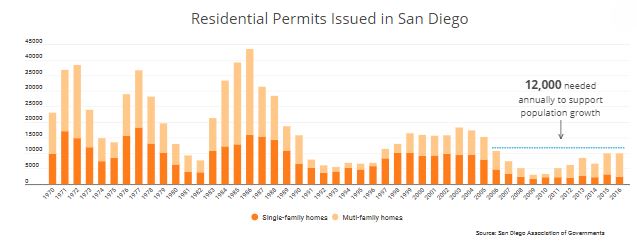
      Public housing built on public land is provides the cheapest delivery mechanism to build cheaper housing for people who cannot afford market rate housing. Bottom line, the land is the cheapest, the labor is well-negotiated, the outcomes are more predictable than using subsidies, waivers, and other regulatory tools to subsidize new construction. The City of San Diego needs to build 12,000 new units annually to keep up with demand (we might build half that on a good year), and we’re trying to double our production with one hand tied behind our back by only relying on private development transactions. We’re in a crisis and it’s time to untie the other hand.

      HousingProductionSanDiego

      The following are my recommendations for how our region’s cities, and City and County of San Diego can begin to build public housing:

      • Build local state governance representative support for Senator Allen’s bill to repeal Article 34 via Honorable Toni Atkins and Hon. Lorena Gonzalez. Because this will need political will from the Democratic/Labor left, public housing offers the incentive of more construction and management jobs and housing opportunities for trade workers.
      • Take the lead in proposing a statewide ballot proposition to repeal Article 34 by obtaining signatures from 8% of the registered voters who voted (12,464,235 total votes) in the most recent election for governor. This is impossible as we’d need 997,139 of signatures @ $6.20 per signature = $6,182,260.00!
      • Lead a local ballot measure to ask for a majority public vote on allowing the county and cities to build Low-Income (Subsidized) housing on City, County, Agency, and State lands. Initiated by either a petition signed by registered voters or via State Legislature such as Ms Gonzalez or Ms. Atkins, which again needs political will from the Democratic/Labor left, offering more trade jobs and housing opportunities for trade workers is the incentive for their support.
      • Build Middle Income, non-subsidized “Essential Workers” housing that is above the subsidized state-defined Moderate-Income Affordable Housing program, which is >120% AMI. Average Median Income (AMI) for all counties established by HUD is $64,800 for 2019, which is $77,760. San Diego’s annual median income is $76,662. Start building Median Income Housing for rent on City and County lands today betting that Article 34 will be repealed and you’ll have future AH housing stock available – This could be done in conjunction with a non-profit education platform to help local citizens strengthen their neighborhoods through small-scale real estate projects. The Incremental Development Workshop trains small-scaled developers to build capacity and value for locals to be education on how to use San Diego’s inherent land values (as owner/developers or trades/labor) to invest in their own neighborhoods, retain their stake in a neighborhoods, and raise values lot-by-lot without displacement. Importantly, this could be financed by allowing local municipalities to borrow against their assets and rental income in the same way as registered providers and the private sector.

      A common fear over this method of delivering AH is the possibility of skewing the housing construction market’s ability to fill any new market demands/needs. Our construction costs today are going through the roof (and has historically) as the ability to attract and retain construction workers in an expensive housing market makes workers scarce. So, the concern about the potential pressure on the existing skilled labor force is very real and illustrates the need for cheaper housing in our region.

      In other places with skill shortages, such as the UK and middle-America, they are turning to establishing factories to create homes using modern modular methods of construction.
      The rise and fall of our housing market influences the amount of Inclusionary Housing fees collected, which exacerbates the one-hand-tied-behind-our-back conundrum. And to build a significant amount of AH, we need new housing starts funded by developers’ contributions and any reduction in these contributions has a considerable effect on the  availability of AH. As a capitalist society there are always uncertainties in the market related to finance, labor force to construct housing, professional skills and shifts in the proportions of dwellings in each of the 10 housing market types.

      Here are the ten (10) types of housing markets in San Diego (and who is responsible for building each type):

      1. Low/Mid-Rise New Construction Housing for Sale (National, Regional, Local developers/builders);
      2. Low/Mid-Rise New Construction Housing for Rent (National, Regional, Local developers/builders);
      3. High-Rise New Construction Housing for Sale (National, Regional, Local developers/builders, Trades);
      4. High-Rise New Construction Housing for Rent (National, Regional, Local developers/builders, Trades);
      5. New Affordable Housing for Rent (Housing Commissions + Non-Profit AH Developers, Trades);
      6. New Special Needs/Workforce Housing (Housing Commissions + AH Non-Profit developers, Trades)
      7. Existing Special Needs/Workforce housing (Housing Commissions + AH Non-Profit developers, Trades)
      8. Existing Housing Stock for Sale (Investors/Homeowners);
      9. Existing Housing Stock for Rent (Investors/Homeowners)
      10. New Custom and Self-Built Housing (Investors/Homeowners).

      There are two (2) additional types of housing missing in San Diego that are available to other human beings in other parts of the world:

      1. Social Housing for Sale (Agencies, Housing Commissions + Trades);
      2. Social Housing for Rent (Agencies, Housing Commissions + Trades).

      A hard truth is that our well-trained construction trades limit worker availability capacity (scarcity) that drives up construction costs. Another hard truth is that cheaper labor doesn’t offer the same level of quality . Affordable Housing built in private low to mid-rise development mostly excludes Trades Labor. And, Trades are used for all high-rise development, for rent or for sale, because of the expert skills needed to construction tall buildings. And, the trades-only construction scenario for AH/Special needs housing is detrimental to the cost of construction but imperative to the political will to build it. In my opinion, this illustrated clearly the failure of capitalism.

      The need for more construction workers is real. The need for housing to house new construction workers to live in is a chicken/egg conundrum San Diego has had to deal with for a century. And, it is a common insistence from the development industry that the nation is suffering from a labor shortage.

      So, the best solution is to cultivate a local construction trade industry, rather than hope to poach workers from other cities. San Diego City College has a trade apprenticeship program that a national developer is working with to building their own General Contracting company to build a new project in San Diego. This is the future of construction.

      These are my recommendations to deal with the labor market via private corporate leadership (Chamber, Trades, Economic Development Corporation’s role):

      • Build up skills to support housing delivery including labor trades, capital program accountants, legal and structural engineers as well planners and surveyors;
      • Assume that some housing will need to be provided with direct involvement of local municipality;
      • Recognize that corporate leadership is central to success in housing delivery;
      • Recognize the role of local industrial strategies in supporting local housing needs for a full range of dwelling types that can house people who can support the local and regional economy.

      These are my recommendations to enable social housing in local municipalities:

      • Understand the Cities, County, and Agencies have different buckets of money to access and land taxation rules than neighboring cities;
      • Recognize in housing finance policy that the number and mix of homes required in San Diego over the next forty years cannot be provided entirely by private sector funding;
      • Consider the role of the municipality as a patient investor in its area;
      • Consider providing all 12 types of housing that might be required for local needs if this is not being met by other providers;
      • Establish a housing and planning delivery team to manage the implementation of all housing plans regardless of public or private proponent;
      • Establish a housing delivery board to monitor progress and delivery;
      • Establish a housing delivery forum of all providers in the area to meet regularly to discuss progress and problems;
      • Establish a housing intervention fund to help overcome issues on individual sites (funding can be made as a grant, a loan or in return for development equity);
      • Promote how housing supports the local economic objectives (e.g. retention of younger professionals and graduates living in and moving to the area);
      • Assess all sites in municipality ownership for housing suitability;
      • Include more detailed housing delivery outcomes in SANDAG’s annual monitoring report;
      • Consider purchasing land for housing as an investment for the longer term;
      • Work in conjunction with non-profit education platforms, such as local Labor/Trades Unions, LISC, and NeighborWorks, to trains locals construction trades and how to be small-scaled developers to build capacity and value for locals to be education on how to use San Diego’s inherent land values (as owner/developers or trades/labor) to invest in their own neighborhood through small-scale real estate projects. The Incremental Development Workshops encourages locals to retain their stake in a neighborhoods, and raise values lot-by-lot without displacement or outside forced gentrification, and;
      • Establish a funding subsidy program through grants for local authority direct delivery of housing and other mechanisms such as by bonding or the general fund.

      I have in my hand a list of 135 known socialized housing projects throughout Vienna that prove this is a viable tool to addressing San Diego’s housing crisis. Thanks to Voice of San Diego and Unsplash for the graphics, and political consultant Andy Kopp for the inspiration.

      Same as it Ever Was… Same as it Ever Was.

      San Diego, Urban Planning

      We live in the south end of North Park, San Diego. The community has been experiencing an urban development renaissance over the past 25 years. Our city’s planning structure begins with city-wide General Plan policies, local Community-scaled planned policies, and then lot scaled Zoning Regulations. North Park’s Community Plans are supposed to guide decision-makers when making major changes to land use decisions and any updates to Zoning regulations. Know that because we are a Charter City, these regulations do not have to be in conformance with our policies (and they aren’t).

      The recently updated North Park Community Plan forged a compromise to ensure that the increase in residential densities enabled mixed-use, walkable urbanism on our main Transit Corridors, El Cajon Boulevard, University Avenue, Adams Avenue (east/west), and our secondary corridors on 30th Street, Texas Street, and Park Avenue (north/south). This ‘upzone’ went along with the ‘preservation’ of older bungalow neighborhoods that need/want more discretionary review for any changes as local ‘preservationist’ agreed to this compromise. It is a win/win plan.

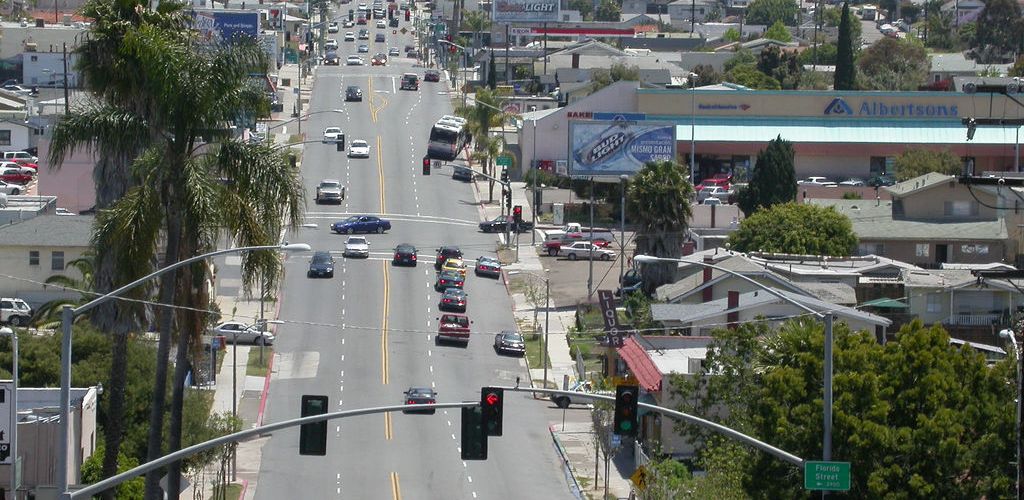
      However, it is our zoning that does the heavy lifting in building San Diego. In updating our local North Park Community Plan the city changed the once customized local zoning rules to city-wide zoning regulations. This backwards, 60’s era, city-wide one-size-fits-all zoning approach (generic Land Uses first rules with a variety of development standards/rules overlays to make each use fit into its context) replaced locally customized zoning that was from the 1980s. Unfortunately, old and new zoning still enables new single-story strip commercial drive thru buildings (new Starbucks, Wendy’s, Sonic fast food stores for examples) on our transit corridors via by-right zoning applications. This 8-year and millions of dollars update still makes auto-oriented buildings easier to entitle and build than vertical mixed-use buildings.

      So, how is North Park’s renaissance happening? There are two main drivers. First, the market demand for housing is driving new development in North Park as it’s an older neighborhood with great parks, streets, entertainment, and historic amenities. Over a decade ago, a local crew of architects-as-developers, led by Jonathan Segal, have figured out that best vertical mixed-use walkable buildings are a half-block off our Transit Corridors as the city planners knew that a transition from corridors to bungalow neighborhoods was needed, so they made very flexible zones to allow either commercial or residential or some of both… which put our best urban buildings closer to historic homes than ON the transit corridor! This creates unnecessary conflicts, leads to displacement of older apartments, but this zone is North Park’s new building area as demanded by the local housing market place.

      Second, the market is driving our internationally recognized Craft Beer industry. This explosion of breweries, tasting rooms, restaurants, and beer halls has been formally enabled by a new ‘artisan’ zone applied throughout North Park’s transition zone mentioned above. New housing and new restaurant/entertainment appeals to the new age employee as the ‘experience’ of living in a real neighborhood refutes their parent’s suburban housing/office park lifestyle… as the next generation tends to do. However, this somewhat smelly “industries” are located deeper into the historic neighborhoods, causing unnecessary conflicts too as they should be located on our main corridors, and not a block or two off.

      In short, our city’s zoning regulations are mostly in conflict with the intent of the updated North Park’s Community Plan. Fortunately, due to a lack of municipal planning expertise, a narrow seam of better new development has risen between the strictly regulated commercial corridors and community-activist guarded historic single-family housing areas. While this narrow seam is working, its not building enough to address our housing crisis and our inability to build high-intensity mixed-use along our corridor, leaving the value of our Bus Rapid Transit investments sitting on the table. This continued shift towards building high-intensity mixed-use development along our Transit Corridors is the North Park’s future opportunity to build value without displacement of existing residents

      san diego apparel america s finest city

      Photo by Stephen Niemeier on Pexels.com

      .

      “Do the Math!” How to Deal with Hot Housing Markets

      San Diego, Urban Design, Urban Planning

      Transect-LA-nathan-dumlao-539610This innocuous quote from a recent Texas Monthly Magazine article (here) shows how easily it is to misunderstand the forces that shape a hot-hot housing market cities:

      “”The problem, of course, is that this idealized urban lifestyle is out of reach for most. The culprits? “Student loan debt, wage stagnation, rising rents, insurance costs, and the lingering aftermath of the Great Recession, which many millennials ran right into at a key career stage,” – Jason Dorsey, President of the Center for Generational Kinetics, an Austin-based research and marketing strategy firm that tracks social trends among millennials and Generation Z.

      Ok, so rents don’t rise when wages stagnate. This is because “the rent” is determined by:

      Wages x Employment ÷ No. of Units Available = Market Rate Rents*

      OK, so while this *equation is simple… the basic point is that the rents are rising in hot housing market cities because our growing upper class wages are booming while the number of units available are limited. Higher wages x higher employment in cities that constrain new development makes for hot markets and high rents.

      With wages somewhat stagnating for the shrinking middle class, we understand that rich/middle/poor people want to live in nice /fun/safe places. And, everyone is willing pay more/compete for access to the ‘good life’ in a city that has great amenities, such as arts, parks, rivers (think Austin and Denver), nice weather, beaches, bays (think San Diego), and most importantly lots and lots of jobs with some or all of this stuff (think Bay Area, Seattle, and Los Angeles).

      This competition is seen in San Diego, as our rent has historically been high for my entire life, with very little fluctuation in either good times or bad. A recent Federal Reserve paper stated the reason for this is attributed to rental rates being determined more by the level of amenities our neighborhood’s provide than merely by supply of housing.

      This factor still fits with the simple equation above as those cities with the good life are too few and far between and those nice places are unwilling to build enough housing to meet market demand… as people continue to look for places to spend their valuable time and money. With that, one neighborhood will be expensive for a variety of reasons, and a similar neighborhood only a few miles away will be stagnant or declining, while still having the same physical access to beaches and bays… just not the economic access.

      What Mr Dorsey fails to understand about Austin is that those few units available in the urban fun/nice hipster areas are being rented by those few Sci/Bio/IT-tech engineers who are in high demand and making significantly higher wages (+$200k/yr) than the regular blue and white collar workers ($60k/yr). This drives up the rent in those few high-demand neighborhoods. Austin, and all cities, needs more housing/jobs with nice stuff in more neighborhoods rather than having big money fight for those few amenity-filled neighborhoods scattered throughout most cities.

      And with that I feel myself sliding into the displacement/social justice trap. As displacement is the nasty common side effect of gentrification (value increases). So, I’ll put this out there again for your consideration:

      The most appropriate urban design response to social justice is to build towards social/enviro/economic (jobs/housing) stability. To be clear, I am not advocating for displacement, but I am advocating for some gentrification in economically static neighborhoods (such as more schools, parks, and market-rate development opportunities) and some economic stagnation (such as subsidized housing and rent control) in hot markets.

      This brilliant study shows that all of San Francisco is an expensive because it is affluent with a growing population and no land easily available for development. And, building more housing would reduce rents as it adds supply to the inherent demand. But, if they built enough new housing to reduce prices it would significantly change the character of the city and its quality-of-life… so, urban design will make a huge difference in how San Francisco builds its future! Go Sonja Truss!

      Ultimately, our big west coast cities currently flourishing on the tech industry (ironically born in San Jose suburban garages) will continue to be successful into the future as our nation’s constricting economy pushes well-educated, financed people into these nice cities. And, they’ll continue to spill out excess jobs into neighboring cities, towns, and transform conventional suburban tracks (which are still being built, btw) into more urban places (despite their fighting this urban shift). Again, urban design is necessary to move our cities into the future.

      By the way… Seattle and Denver have stabilized rents by building more housing. And, a few years ago Denver changed their conventional zoning to a form-based code in anticipation of their 21st century development needs. Need I mention the value of urban design again?