My Taco Shop Theory…

Economics, San Diego, Urban Design, Urban Planning, walkability

I write, draw, and lament often about how great mixed-use, walkable, transit-supported urbanism is for our civilization. In my part of world, San Diego, one our most civilizing characteristics is the local taco shop(s). Taco shops are ours and we do them best, especially in comparison to LA, ‘Frisco, and Sacramento. And I have a theory… “the best taco shop is the second closest taco shop to your home.”

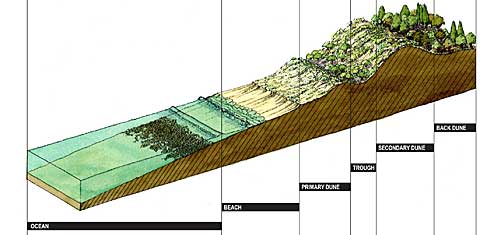
Another theory I subscribe to is the use of the ‘transect’ to design, plan, and build neighborhoods. The transect is an environmental research tool. It is a cut or path through part of the environment showing a range of different habitats. Biologists and ecologists use transects to study the many symbiotic elements that contribute to habitats where certain plants and animals thrive. The urban-to-nature transect outlines our human habitat in a similar fashion. See here: https://transect.org/index.html

natural transect
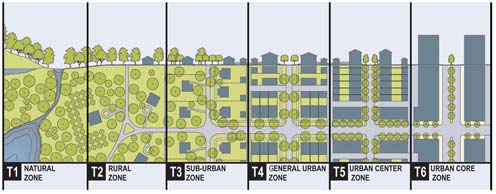
transect

And the Transect Zones (T-zone) range from the most urban, T6, to the most natural, T1. And there are 4 other place types in between. The Transect can be used at the regional scale. For example downtowns are a region’s most urban, thus T-6, and State/Federal parks, T1, are the most natural areas that need to be preserved. Agricultural reserve areas (T2), edge of town suburbia (T3), small town centers (T4), and the middle of towns/cities neighborhoods are mixed-use (T5). And the Transect is best applied at the neighborhood scale.

Each walkable neighborhood, approximately 120-acres, .25 mile distance from center to edge (approximately 1,250 linear feet), and these have at least 3 transect zones within it to provide a mix of uses, places, spaces, and people at different income/life levels. The neighborhood main street center is T5, the neighborhood general area with a few corner stores is T4, and the neighborhood edge is usually T3 that leads to natural corridor or the next neighborhood edge leading to another neighborhood and its main street center.

This my complete, walkable, mixed-use, transit-supported neighborhood with the 5-minute walk from the neighborhood center to edge outlined:

And here are where my local taco shop and trucks are located by Transect-Zone:

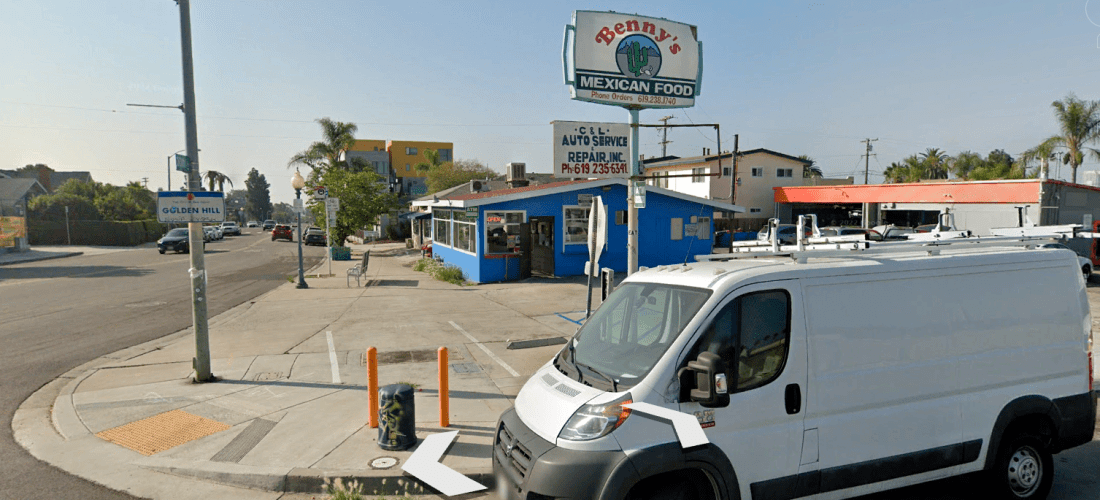
And here is the location of my next and favorite taco shop:

If I took the time, you’d see that my favorite taco shop is on the edge of the next neighborhood to my south. It’s center is located a neighborhood grocery store (Food Bowl, who make great tacos in their deli too). And our older streetcar neighborhoods in San Diego are expertly shaped with neighborhood centers located every 5 to 10-minute walks apart from each other and our #2 Bus stops. And, every neighborhood essentially has a great taco shop located in it. To the north, The Taco Shop is located another half-mile to the north, then another favorite taco shop, open 24-hours, Saguaro’s, is another half-mile from there.

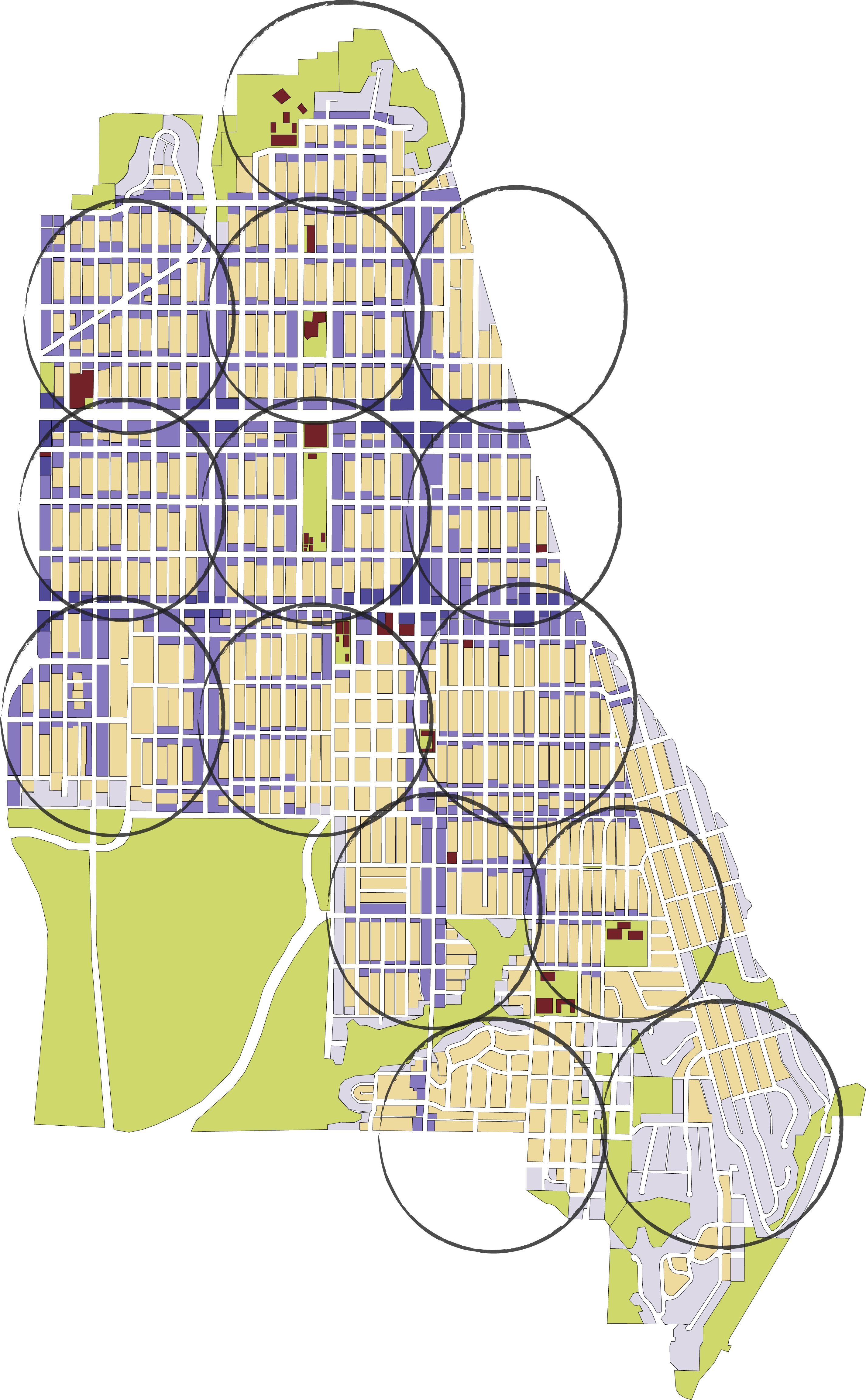
Below is a transect map of the neighborhood’s in the North Park Community Planning Area. My neighborhood is to the furthest south (and half in Greater Golden Hill). The Taco shop is on the edge of the next north neighborhood (see the off-set Upas St intersection). And Saguaro’s is on the edge of the next neighborhood to the north, and so on. Notice they’re all located on 30th Street, the only north/south street connected South Park/Golden Hill to North Park and all of the tacos shops are located on it (and Fern St where it changes names).

One of San Diego’s best cultural elements are our taco shops. When I travel somewhere for more than a few days and return… my first meal home is usually from a taco shop because I need it. And we’re fortunate enough to have a taco shop in most of our urban neighborhoods. I’m thankful for my local, but I eat there too often and it’s staled to my tastes… and it’s too close. A 5-minute walk to/from my house to my local taco shop only burns a few calories compared to the amount of calories served up by my favorite burritos, rolled tacos, and flying saucers.

Walkability Doesn’t End at the Front Door…

Urban Design, walkability

In the city making profession, we use the quarter-mile, or 5-minute walk, as a standard measurement of distance for planning neighborhoods and cities. It is a traditional baseline for a ‘comfortable’ walk before people will choose another mode of transportation1. A half-mile walk, or 10-minute walk, is another standard used to measure walking distance to comfortably access transit facilities.

These distances were first codified in the 1929 regional plan for New York and its 5-minute walking radius diagram by Clarence Perry (top image below). In San Diego 60-years later, Peter Calthorpe’s original Transit-Oriented Development to plan around our Light Rail Stations popularized the walking distance measurement in planning documents throughout the nation2 (bottom image below). And today, walkscore, is used to measure quality-of-life in neighborhoods and cities throughout the world.

An average person has a stride length of approximately 2.1 to 2.5 feet. That means that it takes over 500 steps to walk a horizontal distance of a quarter-mile, or for 5-minutes. Health experts recommend 7,000 – 10,000 steps per day to maintain an average adult level of fitness. And with 2,000 steps being about one-mile, or a 20-minute walk, 10,000 steps is about 5-miles or a little over one and half hours of walking per day.

Those who walk to access daily needs most often are also those who don’t usually drive, children and the elderly. The 5-minute walk to/from a place in the neighborhood is a comfortable walk somewhere for an elderly person pushing a baby stroller, about 1,000 steps. Or for average adults, its a quick visit to the corner market for a daily need or having lunch/dinner with friends nearby without driving and taking up more space for you, your home, plus your car at every shop, office, or home you visit in your own neighborhood. Notice this time and ease of walking only works in neighborhoods with a traditional urban pattern and most definitely not in drive-thru suburbia. In short, it’s a more socially equitable way for more people to access their own neighborhood and their daily needs beyond their home.

Unfortunately, this is where most of our city’s policies, guidelines, regulations, and cultural expectations for walking end. Even our first round of Active Transportation Plans across the nation, see the County of San Diego’s ATP I worked on here, stop at the front door of every building (except New York City’s very good Active Transportation Guidelines that incorporate the placement of a building’s stairs).

It is well-document that walking and bicycling are healthier for us as individuals. It is also well documented that reducing the amount of vehicle trips, miles, and idling time and replacing them with walking, biking, and transportation trips reduces the amount of greenhouse gasses (GhG) emitted into our atmosphere. The burning of oil and gas in vehicle engines is by far the largest contributor to global climate change, accounting for about 30 per cent of our GhG emissions3.

Buildings account for another 30 percent of total U.S. GhG emissions. This is mostly due to their extreme electricity use, for heating/cooling air conditioning and elevators. The taller the building, the more GhG emissions. (LEED serves the purposes of measuring these emissions, but it stops measuring at the the building’s exit door. LEED ND bridges this divide, but it too is an individual certification lacking authority.)

Today’s YIMBY movement advocates strongly for tall, dense, buildings as housing scarcity for individuals has been deemed a more important problem than reducing GhG. This is due to the fallacy that higher-density can only be achieved by higher/taller buildings. That said, YIMBY’s also advocate for urbanism, and the value of walkable, bikable, and transit accessible places. Walkability doesn’t end at the front door of the building.

What does a walkable place mean? It means that you are able to comfortably walk across, horizontally, your neighborhood streets and blocks. The buildings that front onto the streets are connected, compact, and offer a mix of things to do. Then it means that when you walk back home from the corner store, and enter the front door, you are able to walk up, vertically, to your home/flat/unit. This leads to asking what is the value of walkable places?

LEON KRIER WAS RIGHT (As Always…)

It takes almost 33% more effort to climb a flight of stairs, about 15 steps. So walking one floor of stairs is about the same as taking 45 steps on level ground. Walking up a 5-story building, approximately 75 vertical steps, is equal in effort to walking up five flights of stairs, or the same as 225 horizontal steps. Walk up and down a 5-story building, 500 steps, takes the same amount of energy as walking 5-minutes at grade.

Based on the walking classifications from the Compendium of Physical Activity, a 170-pound person would burn approximately 80 calories walking one mile at a slow pace (2.0 mph), so a quarter-mile walk, 500 steps, equals 20 calories burned. This study found that walking up and down five flights of stairs daily is enough to increase heart protection and reduce disease (see here too). 

Traditional, mid-rise buildings are between 4 to 6-stories tall. This height is based on traditional construction technology using locally sourced materials of wood and/or masonry and has been used throughout the world for centuries. It also based on how far people are willing and able to walk, vertically before they choose an elevator and hermetically seal themselves off from the weather in glass and air conditioning (GhG generator). And just as importantly, as demonstrated above, this distance is equal to about how far people are willing walk horizontally before they choose a vehicle (GhG generator).

It was Luxembourg’s Leon Krier whose transformative traditional architecture and urbanism polemic in the 1970’s and 80’s shaped America’s New Urbanism of the 90’s and 00’s. His radical at-the-time advocacy led to the traditional mixed-use, walkable, transit-supported urbanism being the standard practice of today. His work can be found across the Google, and here during in our Covid Conversations.

DO THE MATH!

Walkability is both healthier for the individual and our collective climate. It’s just math! A traditional walkup building set in a traditional neighborhood pattern is able to reduce GhG emissions by +60%. And an inactive lifestyle contributes to 1 in 10 premature deaths. About 110,000 deaths annually could be preventable if US adults increased moderate-to-vigorous physical activity by even 10 minutes per day. Unfortunately, the YIMBYs, NIMBYs, and self-referential modern designers still advocate for an unsustainable, drivable, man-as-a-machine lifestyle that’ll leads us to a WALL-E world…

The Moose out front should of told you, folks (to think less about consumerism and instead focus on protecting our humanity)!”

(The park is our planet as predicted in WALL-E, and the moose in front of Walley World is Leon Krier)

Housing for 1 Million New New Yorkers

Social Justice, Transit, Urban Design, Urban Planning

Last week, Vishaan Chakrabarti, founder of PAU, unveiled his firm’s housing analysis via The New York Times. The PAU founder says there is space for up to 520,245 homes in the city on roughly 1,700 acres of unused land. Most of it would be enacted above existing single-story commercial spaces.”

The article I read about the proposal, here, said they used, “available data on vacant lots, flood-prone areas, and the location of subway stations and other mass transit options.”

Uhm, well, okay… As stated in my previous two posts, that after 30+ years of illustrating the benefits of mixed-use, walkable, infill, transit-supported design, planning, architecture, and building, why are we still trying to sell the obvious? The NYT article references how infill is still controversial… based on Boomer NIMBY-ism. Or the lack of political courage to do what is right over the long-term.

Today it is an incredibly hard lift to get short-term politicians to address long-term issues against perceived short-term public interests, such as homeless on the streets (regional issue), interest rate fluctuations (national issue), and gas prices (international issues).

California’s housing crisis became a political crisis due to the technological advancement of social media to organize and coordinate a series of disparate Bay Area groups into one large YIMBY movement.  ‘Yes in My Backyard,’ led by Sonja Trauss, shifted San Francisco’s political approach to its acute housing and homelessness crisis to make these issues the city’s number one issues, beyond potholes and loss of parking spaces. The political structure of San Francisco, Oakland, San Jose, Sacramento, Los Angeles, Seattle, Portland, and San Diego followed in suit.

Social justice is today’s environmental movement of the 60s/70s, and economics in the 80s-00s. The third element of sustainability, we are learning how to build a more accessible and socially equitable city, which is why bicycles, walkability, shared mobility, complete streets, and transit-orientation are the focus of city making today. This housing crisis is a linchpin of the equity issue and I believe social equity/justice is a political crisis leaders must address. State laws are providing political cover for elected officials to pass new rules necessary to build more housing.

Lessons learned from SF’s YIMBYs to create a political crisis that makes change are:

– Organize various groups into one single-purpose, general issue group (with a catchy name)

    – Use new technology (social media expanded during their rise)

      – Put a charismatic leader with excellent public-speaking skills in front of the organization.

      – Provide political cover for our risk-adverse Mayor(s) to approve controversial housing projects.

      – Find and maintain the support of philanthropist.

      – Find and support like-minded candidates running for office on this project.

      – Sponsored policies dedicated to housing.

      – Educate citizens via various media to show how plans can turn into better projects. Provide reasonable tradeoff scenarios to educate everyday citizens. 

      To make this more citizen specific, this aligns with 5 Reasons People Accept Change (borrowed from reasons why people buy retail products):

      – Solves my pain – Homelessness is San Diego’s greatest pain.

      – This connects me to community – Everybody loves San Diego.

      – This makes my life easier – Able to conveniently access and enjoy beautiful spaces and places

      – This feels luxurious – San Diego is as beautiful as any place in the world, accessible to everyone.

      – This will make me more money – Our city can attract the World who’ll spend their money here.

      The following are ways to shift our cultural expectations necessary to change status quo, which takes time:

      Forces Within your Society: Homelessness is first. And then there are local advocacy groups or local connector/influencer people to collaborate with and an opportunity for coalition and capital building.

      Forces Between Societies: Regarding housing, State Law is the agent of change.

      Changes in our Natural Environment: Increased housing creates the need for high-quality amenity spaces. And climate change with longer, hotter, drier summers and wildfires are the low hanging fruit and take change out of our hands.

      Invention/Stimulus Diffusion: The new-new is faster smartphone technology, which is changing how we get around our cities with shared mobility and on-demand. Millennial culture ideas are making changes via smartphone technology inventions.

      Agents of Change. The best singular agents of change, are people who are culturally allowed to propose, advocate for, and succeed in making change are the following:

      Students/Faculty: Schools are teaching the future and past, but not status quo.

      Attorneys: Their job is manipulating the law and regulations.

      Designers/Artists: All projects are new and therefore represent change.

      Wealthy: Philanthropists are champions.

      Advocacy Groups: But they lack any authority.

      Long-Term Politicians: We have few in San Diego.

      Not Agents of Change. The least acceptable, singular agents of change, people not in the cultural expectations position to propose such and will eventually be your foil are:

      Chamber business interest/developers: Constituency groups that are risk adverse to change.

      Government Departments/Staff: They’re trying to equitable to all citizens, as change = winners/losers, and they’re not paid to make change.

      Churches / Religions: Maintain status quo.

      Community/Preservation Groups: Maintain status quo.

      Impoverished: Don’t experiment on the poor, they don’t have the resources to sustain failure.

      Short-Term Politicians: Our city council, Mayor, and County Supervisors.

      Politicians need that city-wide vision/principles/image to assist them in navigating the dichotomy of individual/small group fears versus larger city/common interests that this singular new project brings the city. And infill that builds mixed-use, walkable, transit-supported urbanism is our best sustainability tool.

      San Diego/Tijuana is a World Design Capital

      San Diego, Urban Design

      This is an excellent article about the need for design innovation in SoCal, and very apropos to San Diego. In short, the author explores ideas about the need to ween ourselves off of our car culture and recommends Building Expositions: Design thinking is applied to urban design through rapid urban prototyping, and as such through the primary tried and proven vehicle of international building exhibitions, which have had a successful track record for more than a century.

      San Diego/Tijuana has a history of important building innovations, starting with San Diego’s two early 20th century world expositions. First with the invention of Spanish Revival in 1915 by Bertrand Goodhue, and then with suburban sprawl in 1935 by the Federal Housing Authority. The suburban auto-oriented pattern of building was first exhibited in ’35’s FHA suburban model homes by Neurta and Eckbo, and it changed the world.

      In the 1950s, San Diego also invented Climate Change (Scripps GhG/carbon measurements by Roger Revelle and Charles Keeling), which dramatically changed our world too. We invented the modern LRT system, Transit-Oriented Development (Peter Calthorpe/Mike Stepner), modern ranchette house (Cliff May), modernist tilt-up construction (Irving Gill), Salk Institute (Lou Kahn), downtown urban malls (Jon Jerde/Frank Wolden), and we have UCSD’s Teddy Cruz’s study on cross-border construction techniques found nowhere else. Our latest UCSD/Tijuana Migrant Shelter (Teddy Cruz/Fonna Forman) and Cross-Border Terminal (Ricardo Legorreta/Blackson – yeah, I did the Site Plan) are important innovations too. Our bordering cities have a successful history of building innovation that needs to be celebrated.

      This is the value of next year’s WDC2024. The World Design Capital is a legacy thread that builds upon our history of innovation and has the potential to reshape our future.

      Buildings are spaces and places we inhabit as humans. Virtual Realities, Artificial Intelligence, and Autonomous Vehicles are appropriately named… they’re fake, false, impersonal, and limited. Salk/UCSD’s CAVE has faded after so much bluster in 2007, but is an early 3D/VR innovation, and something to be proud of. We need to build them to test our 21st century spaces and places, and share the risk/financing/rewards. For example, a heavy timber building was quietly built and successfully earthquake tested recently at UCSD. We need to test/build modular as well as Doug Austin’s concrete prefab patent idea. We need a place to share this knowledge and get onto our less suburban, auto-oriented future our climate and society demand.

      UCSD is leading our region in design thinking, and its Park/Market facility is our region’s design creativity Hub. It’s the center of our WDC2024. We’re fortunate to have both coincide today.

      When debating NIMBYs, I like to say that a community’s “character” is found in its memory (history) and expectation (vision). This idea of an International (USA/MEX) Building Expo center is a great idea and we have a history of success with it. Now we are able to ideate a new vision for our region during WDC2024 and beyond. It’s a character defining moment!

      And I wish to carry this idea through the WDC year as one of its on-going legacy goals. #LFGSD!

      Balancing the Math!

      Economics, Social Justice, Urban Design

      In general terms, the equation* to figuring out what the market rate housing rents are is to find the average local wage, times it employment opportunities, divided by the number of housing units available (*this is not a real math equation, it is assembling the elements that determine how the market place sets rents). While this equation is too simple, the basic point is that the rents rise in economically hot housing market cities because our growing upper-class wages are booming while the number of units available are limited. Higher wages times higher employment in cities that constrain new housing development equates to hot economic markets and higher rents.

      Wages have somewhat stagnating for the shrinking middle class since the Great Recession. And those who are able to are willing pay more and compete for access to the ‘good life’ in a city that has great amenities, such as arts, parks, rivers (Austin and Denver), nice weather, beaches, bays (Miami and San Diego), and those cities with a lot of jobs and amenities (Bay Area, Seattle, and Los Angeles). This amenity factor still fits with the simple equation above as those cities offering jobs and amenities are too few and far between. And those few safe, amenity and job rich places are unwilling to build enough housing to meet market demand. As people continue to look for places to spend their valuable time to inhabit, wealthy cities will have those neighborhoods that remain expensive for a variety of reasons, while a similar neighborhood in the same city, only a few miles away, will remain stagnant or declining economically and socially.

      Cities have a spectrum of economic value, from high to low, in context. Every city has a limited number of housing units available in high economically valued and amenity-filled neighborhoods to be rented by those few high wage workers who are in high demand and making significantly higher wages (+$200k/year). While the majority of a city’s middle class workers (+$60k/year) live in middle to lower economically stable and amenity-less neighborhoods. These new higher wages jobs drive up the rent in those few end-of-the-economic-spectrum high-demand neighborhoods and spill over into the edges of the middle class neighborhoods driving up rents and creating scarcity of middle-income housing (if more is not being built).

      The most socially just urban design solution is to enable and build more housing and jobs with amenities in more neighborhoods rather than allowing for higher wage earns compete for those few amenity-filled neighborhoods scattered throughout most cities currently experiencing job growth. Importantly, these wages, number of units, employment opportunities and the need for more housing production issues are only relevant for stagnant cities and towns across the United States Rust Belt and Midwest states. Which moves us into social equity and justice issues with displacement in these high growth cities and neighborhoods. Local people who are displaced from their long-standing homes is the unjust effect of gentrification as values increases. While increased investment in an area has positive outcomes, gentrification associated with displacement of long-term residents deny citizens the ability to benefit from new investments in housing, healthy food access, or transit infrastructure.

      To physically improve economically stagnant neighborhoods, with value generated from economic development and raise incomes, some manageable level of gentrification, minus displacement, is needed to improve and rebuild schools, parks, and market-rate development opportunities. Adding to this conversation is how work and shopping is physically changing in our neighborhoods, making 1960’s economic development models obsolete and new ways of building our neighborhoods and economies are making a huge difference in adding housing in older, pre-auto dominated neighborhoods. The auto-dominated suburban sprawl areas are in need of different tools to retrofit them. Conversely, in growing economic value markets, some manageable level of economic stagnation is necessary to enable more people to participate in the local jobs and amenities, such as subsidized housing, rent controls, and taxes.

      San Francisco is an expensive because it is affluent with a growing population and no land made easily available for development. Enabling and building more housing would stabilize or reduce rents as it adds supply to the inherent demand. New amenities, new design housing design models, and new neighborhood patterns are emerging. And with enough new housing to reduce prices and mollify its globally hot market rates for housing, the quality of the city’s urban design will make a difference in how San Francisco attracts new wage earners and retains its aging and long-standing citizens.

      Understanding this need to update its codes and design expectations, Seattle, Portland, and Denver have stabilized rents by building more housing. Using new zoning tools to allow for more housing in existing neighborhoods, these cities successfully changed their conventional zoning to a more form-based code type in anticipation of their 21st century development needs for mixed-use, walkable new urbanism. Form-Based Codes, or Objective Design Standards, prioritize where a building fits in its neighborhood context over the singular building’s primary land use. These cities reversed their once decimated social and physical fabric of their downtowns and historic neighborhoods by connecting and enabling isolated and segregated pods of development into well-connected and economically stable neighborhoods. And striking that balance between stagnant and hot economic markets.

      Objective Design Standards are Form-Based Codes

      Urban Design

      Posted on: https://www.cnu.org/publicsquare/2023/01/26/objective-design-standards-are-form-based-codes

      The state of California is responding to the nation’s second highest housing costs (behind only Hawaii) with regulatory reforms that promote form-based codes along transit lines and commercial corridors.

      California’s long standing “Not-In-My-Backyard” (NIMBY) culture has exacerbated the problems of high housing costs and homelessness. Over the past 50 years, conventional zoning ordinances and entitlement processes have conspired to support NIMBY intentions to stop new housing from being built near existing homes. But six years ago, state legislators began passing laws to address California’s acute housing crisis. 

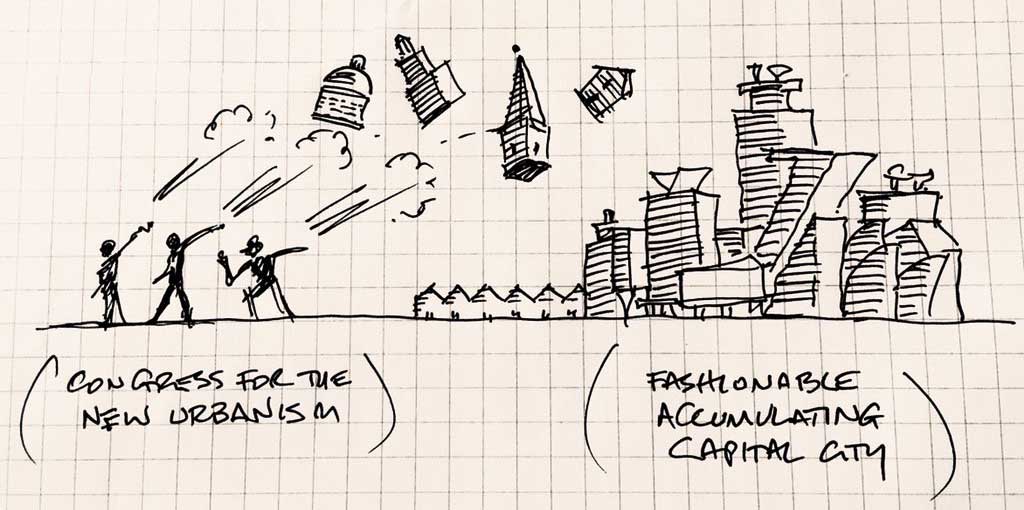
      These bills are removing local policy and regulatory impediments to more housing via Objective Design Standards (ODS) with Streamlined Permit Processing. The intent of ODS is to build more affordable and attainable housing along transit and strip commercial corridors that are ripe for redevelopment. The Congress for the New Urbanism (CNU) has been championing these two important issues for over 30 years. 

      The influential Charter for the New Urbanism had its roots in California, where many of CNU founders helped write the Ahwahnee Principles in 1991 (the principles were, essentially, a first draft of the Charter). Unfortunately, the state, like much of the nation as a whole, continued to promote sprawling development patterns for three more decades. And yet, with 39 million residents, California is often at the forefront of regulatory and cultural trends. The Golden State’s land use reforms could have an important impact beyond its borders.

      Since 2017, CNU and California legislators agree that many of the barriers to building new urban housing are found in outdated zoning codes. Form-based codes (FBCs), developed by new urbanist practitioners in cooperation with cities and developers, are land use regulations that facilitate more predictable built outcomes, with explicit design standards that shape a community’s physical form. Both FBCs and the California’s mandated ODS are presented in clearly drawn diagrams and other visuals to show what is allowed without relying on the discretion of a city staff member and hearing bodies. 

      In 2003, Andres Duany and CNU-California Chapter members provided research that influenced Government Code section 65302.4, promoting the language and diagrams of form-based codes: “This tool achieves certainty over the physical outcome of land use and development decisions while enhancing flexibility to create more infill or infrastructure as needed. Cities in California that have used form-based codes, such as Ventura, Benicia, and Petaluma, provide examples of this practice.”

      Drawing by Howard Blackson

      The state’s ODS language first appeared in SB 35 in 2017, in the Housing Accountability Act. California cities are now required to streamline new development reviews using ODS. These regulatory standards are the now the only basis for cities to deny eligible by-right housing and mixed-use projects. 

      The following series of state laws require ODS:

      SB 2 Building Homes and Jobs Act (2017) provides technical assistance to help cities and counties prepare, adopt, and implement streamlined permit processes housing projects using Objective Design Standards (ODS). The California Department of Housing and Community Development, in coordination with the Governor’s Office of Planning and Research, developed this ODS toolkit to explain how these are more predictable and easier to interpret for all stakeholders, including decision makers, staff, applicants, and members of the public. 

      SB 35 Affordable Housing Streamlined Approval Process (2017) creates an opt-in program for developers that allows a streamlined ministerial approval process for developments in localities that have not yet made sufficient progress toward meeting their regional housing need allocation (RHNA). Eligible developments must include a specified level of affordability; be on an infill site; comply with existing residential and mixed-use general plan or zoning provisions; and comply with other requirements such as, locational and demolition restrictions. The streamlined, ministerial entitlement process relies on objective design standards.

      SB 330 Housing Crisis Act (2019) require a housing development project to comply with objective, quantifiable, written development standards, conditions, and policies appropriate to, and consistent with, meeting the jurisdiction’s RHNA share.

      SB 9 Housing Development (2021) requires ministerial approval of a housing development of no more than two units in a single-family zone (duplex), the subdivision of a parcel zoned for residential use into two parcels (lot split), or both. Authorizes a city or county to impose objective zoning, subdivision, and design review standards.

      AB 2668 Planning and Zoning (2022) further amend SB 35 by removing perceived ambiguities in the law regarding the application process and the local review process. And when a local government determines that a development submitted pursuant to this section is consistent with its objective planning standards, it must approve the development.

      SB 6 and AB 2011 (2022) rezones commercial areas on major boulevards for three-to-six story residential development that includes labor standards and health care requirements in a bid to improve conditions for construction workers and will go into effect July 1, 2023, until January 1, 2033. These require cities to enable a by-right, streamlined, ministerial approval process for multifamily housing with Affordable Housing developments located on commercial corridors using specified site criteria, objective design standards, and prevailing wage labor standards.

      In December, 2022, the Form-Based Codes Institute at Smart Growth America announced that Bay Area design firm, Opticos, won the 16th annual FBCI Form-Based Code Award for the firm’s Objective Design and Development Standards in Marin County, California. The award jury selected these ODS regulations as a model form-based code. Marin County’s ODS/FBC implements Marin County’s Countywide Plan through context-specific standards based on local development patterns.

      Cities are responding to ODS requirements in several ways. Many are simply ignoring the requirement and awaiting future state enforcement. Others are taking their current subjective standards, striking out subjective language, and hoping for the best. Still others are using dedicated state funds to hire experienced California new urbanists to reform local zoning via FBC models, such as Marin County, Santa BarbaraLos Altos, and Carlsbad.

      This ODS/FBC approach contrasts with conventional zoning’s focus on segregation of land uses, and the control of development intensity through abstract and suburban measurements (e.g., Floor Area Ratios, dwellings per acre, setbacks, and parking ratios), followed by a series of discretionary review permit processes, which historically has not provided enough housing and led to the state legislator’s intervention. In short, FBCs and ODS-explicit standards allow for faster permitting processes that are better regulatory tools to provide more housing on infill development-ready corridors. Let’s continue to reform California’s regulations to build more places that are transit-supported, walkable, sustainable, and enjoyable for everyone.

      Find additional Objective Design Standards and Form-Based Code information herehere, and here.

      IN SEARCH OF EQUILIBRIUM…

      Social Justice, Urban Design, Urban Planning

      Contemporary North American urban design tools provide a pathway for a more sustainable future by their ability to balance the competing economic, environmental, and social equity interests at the region, city, neighborhood, block, and lot scales. These Covid years appear to have accelerated development patterns that have been gradually shifting over the past three decades towards more sustainable outcomes. The United States cultural shift towards more urban living is well documented (Ed Glaeser, Triumph of the City, 2012). And contemporary urban development expectations are being built today as originally formulated by the Congress for the New Urbanism (CNU) practitioners in the early 1990s (Peter Katz, The New Urbanism, 1993).

      These three pillars of sustainability, environmental, economic, and equity, provide a structure for measuring or testing North America’s design trajectory today. The United States’ historical values, attitudes, and prejudices that built our 20th-century traditions, culture, cities, and buildings are being re-examined and deconstructed in today’s social equity and justice moment. We acknowledged the environmental pillar in the 60s and 70s. We learned to understand the economics of sustainability in the 90s and 00s. And this past decade we are immersed in a meaningful and healthy understanding of social equity.

      In the past, our culture (music, socializing, celebrations, food, worshipping) had secure foundations in public buildings, streets, squares, and plazas (churches, concert halls, theaters, pubs, and markets), and less so within the private home. Then the generation of the mid-20th century added the new by-products of the industrial revolution with television, cars, the highway, and suburbia to these public and private places (drive-in theaters, drive-thru diners, freeway overpass protests, tv movies, tv evangelists, tv news, home theaters, home cafes, home entertainment, backyard pools), which shifted our culture towards a more private life.

      Today, we are adding smart phone technology to these public and private spaces while shifting again, but this time away from insular private suburban culture and transitioning towards a more balanced public and private life. These smart phones are our 21st-century version of urban renewal, allowing us to re-inhabit and re-animate public buildings, streets, squares, and plazas cheaper, faster, and with more friends and family. Within a century, everything in our culture changed with how we share music, socialize, celebrate, eat, worship, and take selfies with smartphone technology in our daily lives and cultural norms. Importantly, due to the global pandemic, the design responses to shaping our cities, towns, and building are dramatically changing again.

      … in preparation of our ecological Pearl Harbor moment.

      Climate Action Plan, Social Justice, Urban Design, Urban Planning

      In designing our cities towards economic, environmental, and social equilibrium, we are able to achieve an ethical and sustainable approach to city building. The next few posts will be an exploration of the history, present, and future role of urban design in building regions, cities, towns, and neighborhoods towards a more sustainable city. As North America transitions towards more human-scale urban development patterns in its post-industrial society, and more rapidly in response to the urgency of the global pandemic, urban design is able to incrementally guide cities and neighborhoods towards more sustainable global outcomes. Our built environment’s acute response to the pandemic has prepared our society to respond immediately to forthcoming climatic calamities. The late 19th to mid-20th century of industrialized modernist era designed development, suburban sprawl most notably, are complicit in the scandalous emission of greenhouse gases that have rapidly changed our climate and resulting environmental and social malaise our world is experiencing today. The three pillars of sustainability, environmental, economic, and equity, provide a structure for measuring or testing North America’s design trajectory today.

      The United States historical values, attitudes, and prejudices that built our 20th century traditions, culture, cities, and buildings are being re-examined and deconstructed in today’s social equity and justice moment. We acknowledged the environmental pillar in the 60s and 70s. We learned to understand the economics of sustainability in the 90s and 00s. And this past decade we are immersed in a meaningful and healthy understanding of Social Equity. Depending on local context, the next urbanism will move our urban design processes towards achieving an equitable balance between these three pillars as the the most appropriate urban design response to social justice and economic issues is to build towards environmental, social, and economic stability or equilibrium.

      The Next New Urbanism

      Transit, Urban Design, Urban Planning

      This Covid year has accelerated development patterns that have been shifting over the past decade, and as originally formulated by New Urbanists 20 years before. Do you support transit-oriented development? Participating in charrettes? Reforming your zoning with form-based codes? Then thank a New Urbanist. There are many prominent patterns emerging right now, including less commuting; more home/work balance; less industry expansion; and more technology-based business growth in a post-industrial economy.

      Detroit Shifting Towards Industrialization Patterns in the 20th Century.

      These shifts are changing the way we work, just like the industrial revolution changed our world 130 years ago by creating new building types and city-making technology with the invention of steel. In response to that revolution, our cities were reconfigured with skyscrapers, blocks of offices/factories, highways, and cars.

      Many cities were reconfigured during that time, but Detroit is our nation’s most dramatic shift to and from industrialization patterns in the 20th century.

      Now, as we shift into our post-industrial age—and deeper into the age of climate calamity—we are able to measure both its successes and failures. For example, classicism works best at the human scale, but it failed us at the industrial scale when it became an ornament/style and a fascist/authoritarian tool. The international style failed us at the human scale but is ubiquitous because it’s faster, easier, and cheaper to build. And modernism was a disaster at every scale (Google Léon Krier; he was right).

      We are once again entering a brave new era with the opportunity to create a balanced approach to architecture, building types, and city-making techniques that are intended to civilize and modify the best and worst of our industrial advances with the best of our human-scaled buildings and places. By using a full spectrum of 21st century placemaking tools, the Next New Urbanism is able to advance the human condition toward a more sustainable future.

      .

      Pre-Industrial and Post-Industrial Urbanism… in search of Equilibrium.

      Industrialization (or The Education of Howard Blackson)

      Climate Action Plan, Leon Krier, Urban Design, Urban Planning

      Industrialization via the internal combustion machine changed the world (or the Dynamo as described in the great autobiography, The Education of Henry Adams) when it created steel that created new industrial scaled building types. The factories, offices, and skyscrapers were invented in the late 19th century. And because this invention happened during our western civilization’s Neoclassical era, this familiar classical architecture was applied and used to ‘humanize’ these new buildings. However, because the building forms were new, the classicism was applied as a façade, and thereby is ornament… or this mismatched scale made classicism more of a style than a building technology.

      A New Age Industrial Scale Office Building Expressed in a Classical Architectural Style, 1920
      A New Age Skyscraper in the Classical Architectural Style.

      The technology of building at the human scale was obliterated by the modern industrial materials, energy, and resulting scale. Along with these new engines and buildings, new forms of mobility rose as well, trains, streetcars, and then automobiles transformed with the age. The industrial scale of car production created another mismatch in our traditional city environment. Industrialized suburban sprawl was fueled by this auto production.

      Leon Krier Alerted us to this in the Early 1970s.

      Modern architecture formed in a parallel track. Le Corbusier’s 1923 book, ‘Towards a New Architecture‘ responded to this new scale w/an industrial design aesthetic post WW1. And until post WW2, cities used both classical and international styles on modern scaled buildings and places. And I am writing this next sentence as carefully as possible because it is an extremely volatile subject… it was the WW2 fascist Axis power’s adoption of classicism as an authoritarian tool at an industrial scale that shamed the use of classicism almost out of existence for generations in both academia and society’s elite. For such, classicism was rightfully deemed a failure. Leaving us limited to only one architectural tool, the untested International Style/modernism, to integrate industrialization into our cities over time. And it eventually failed too.

      Industrial Scaled Buildings Expressed with International Style Architecture.

      Classical style failed us architecturally at the industrial scale. It had worked fine for thousands of years pre-industrial age and scale. And the International Style failed us urbanistically when applied to the pre-Industrial city. And I dare say the Industrial scaled city (suburban sprawl) has failed use urbanistically as well. This was a lesson Frank Gehry’s ‘Bilbao Effect’ taught us. That the traditional city works great and modernist architecture fits in it well in juxtaposition to it and its classical architecture… adding complexity and excitement to the same old classical buildings set in the same old traditional streetscapes.

      Bilbao’s Big Idea Wasn’t, “Hire a Starchitect!” It Was the Architectural Tuning of Place to Create Complexity!

      The following are general lessons learned. Modern architecture works fine above the traditional city as long as it doesn’t meet the street/ground. And, classical/traditional architecture works well at the human scale when it touches the ground, but it has to be at the small block and up to mid-rise scale (not at an industrialized size). The traditional city pattern works best to make urbanism. Modern architecture works well when set in natural spaces.

      The Salk

      Using all of these tools today allows us to build better cities, places, and experiences. A century and change later, we no longer need to censor one while villainizing the other. They both work fine in certain situations and not so well in others. These are just tools that can work together if we understand how to use them.

      Expanding on Leon Krier’s Tuning of Architectural Settlements with Classical and Non-Classical Buildings Creating a Variety of Place Types.

      We are unfortunately in a new climatic calamity era and are thereby fortunately free of the surly bonds of mid-20th century style wars. I find it maddening that designers and urbanist still argue over style when industrialization is the root cause of our current climate/social calamity! We industrialized work and segregated our society. We industrialized our food and have put our health at risk. We used industrialized machines to emit coal and oil carbon particles into our atmosphere and are heating up our finite planet. We industrialized our health care and extended our lives and increased our population, so it has its merits too. What we need to address is that most people still see industrialization as the only tool to fix what originally caused these calamities… truly, a modern day Aesop’s fable.

      In our new 21st century post-industrial/climate calamity era, we are now able to use every tool available to us to build more sustainable cities and places that range from More Industrial to Less Industrial / More Traditional to Less Traditional depending on its context.

      Finally Free to Design Using all of our Tools in the Toolkit!