Whatever...

One Size Fits One… (and it’s the worst one)

Transit, Urban Design, Urban Planning, walkability

The ubiquitous space, shape, but highly volatile speed of the car is much larger and faster than the universal space, shape, and speed of a human. Yet we continue, since post WW2, design and build everything and everywhere for space, shape, and volatile speed of the car. Streets widen, ground floors are parking lots, people are pushed towards the edges, and cars dominate our landscape. This is what ruins downtowns and isolates small towns. Cars are a suburban mobility tool.

That’s not say we need to ban cars. They do somethings great, such as get lumber, while not as good at others, such as exercising. The fact is that cars are best served for disparate suburban expanses. Walking, transit/buses, and bicycles work best in more urban areas. Cars work great in shorter-commutes and throughout suburbia. Trains, airplanes, and ships work best for long commutes.

The New Urbanism was new because it worked to humanize the car in cities, small towns, and new towns. We’re now moving into the Next Urbanism (and I write about this throughout this blog and speak about on podcasts, such as Kevin Klinkenberg’s Messy City). And as humans, we should be designing and building everything everywhere to accommodate for humans first, letting the right mobility serve us throughout the spectrum of urban to rural contexts.

Downtowns (regional centers) are marginalized by our 1.5 cars per person maxim (Spend 5-minutes walking around Downtown San Diego). Small towns are isolated by freeway by-passes, which need both regionally accessible cars and local people to be economically viable (think Ramona, Julian, and Jacumba, if in San Diego). The industrial era invention of cars and suburban sprawl go hand-in-hand, the built each other. Unfortunately, both cars and suburbs are inhumane and detrimental to our economy, environment, and cultural cohesion (See Sabre Springs).

The next urbanism means making downtowns less car-oriented, small-towns car-supported, and car-happy suburbia having sub-regional centers that are more urban/humane. This place, a small district in Tempe, AZ, Cul-de-Sac, is an example of the Next Urbanism… building more urban, sub-regional centers in the vast sprawl of suburbs surrounding downtown’s regional center. And, by the way, Opticos Design, Inc. is one our best architecture and coding companies.

Seville

Controlled Complexity is the Spice of Life

philosophy, Urban Design

This headline/article was in today’s The Overhead Wire, “Complex urban streets encourage safer driving.” Yeah, when you take the complex river and stuff the water flow into a culvert it reduces the complexity and the energy is drained quicker… adding complexity keeps the energy stored in the system/network/place. This is stated in the 2nd Law of Thermodynamics, as analysed by James Howard Kunstler in his fourth non-fiction book, The Long Emergency: Surviving the Converging Catastrophes of the Twenty-First Century,

“... ordered flows drain entropy at a faster rate than complex disordered flows. Hence, the creation of ever more efficient ordered flows in American society, the removal of constraints, has accelerated the winding down of American potential, which is exactly why a Wal-Mart economy will bring us to grief more rapidly than a national agglomeration of diverse independent small-town economies. Efficiency is the straightest path to hell. (p.191)”

Yes, the more complex a river, a street, an economy, and our lives are, then the more energy we have within them to savor, enjoy, and experience them. It’s when we’re shopping in a Wal*Mart, walking along a box culvert creek, driving on a freeway, and being isolated do we more quickly entropy and lose our energy. Now, that doesn’t mean we thrive in chaos and disorder, we need both. But not just one or the other. In places of great chaos, more order achieves thermodynamic balance. In other places of great order, more chaos helps it achieve its equilibrium. This achieving equilibrium, between complexity and simplicity / chaos and order, is the basis of my economic, environmental, and social equity philosophy.

Existing Context

A City Hall Worthy of San Diego

Public Space, San Diego, Urban Design

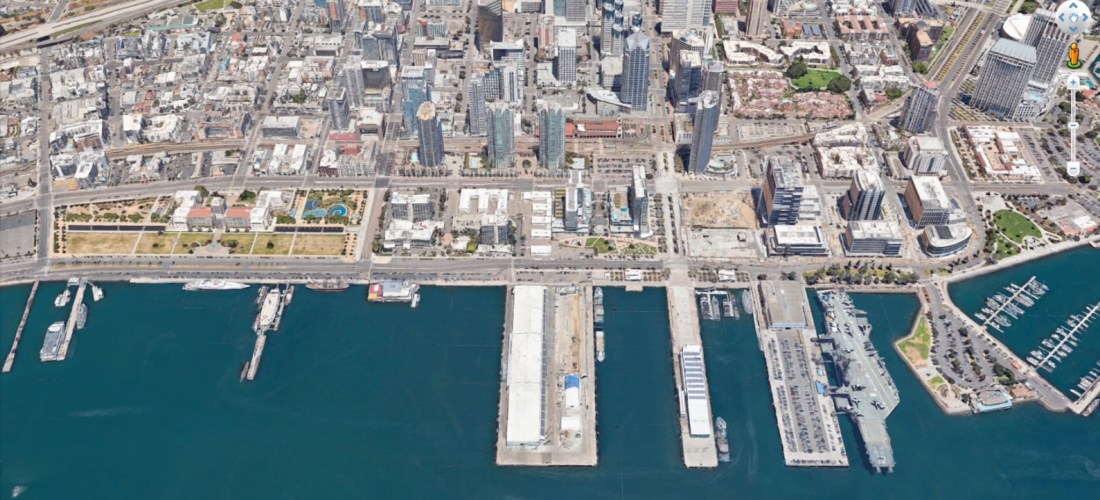
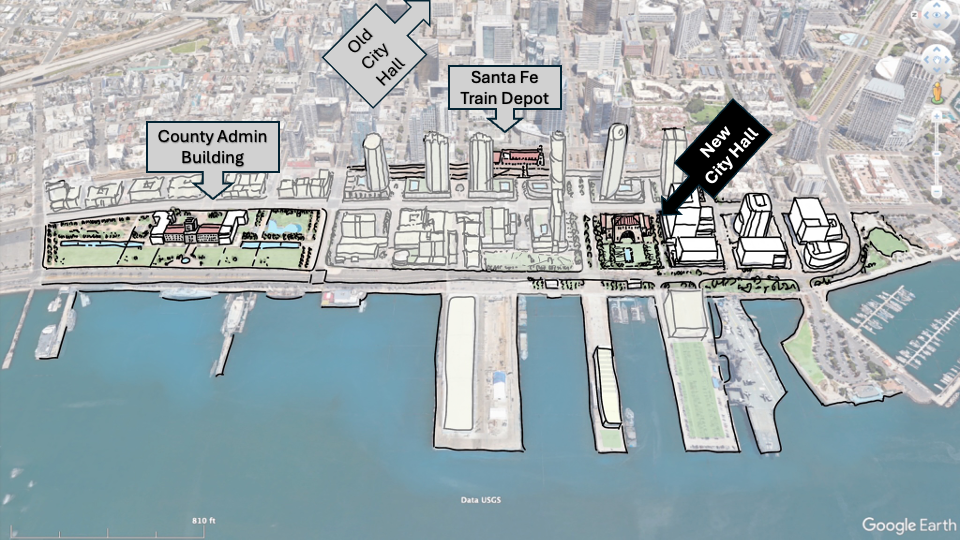
Let’s Rethink City Hall… and put it back on our waterfront! Let’s show our civic pride in reconnecting the city to our great bay! And all of these IQHQ buildings are empty anyway. We can trade Papa Doug Manchester 101 Ash for the Broadway & Harbor block, and build a great and beloved grand City Hall. City can lease the existing buildings for administration/staff offices and everyone, from citizens to staffers, will feel good about going to the bayfront to govern our great city.

San Diego has a history of moving (after burning it down down) city hall, starting in Old Town (burned), then to Market & 5th, Waterfront, and C Street (should be burned), which has never been a beloved place anyway. It too was just a development scheme by C. Arnholt Smith… let’s make it work for us this time.

Our important civic buildings should be located on our best sites, and Broadway & Harbor is that. Use the C Street land sale $$ to build a new Chamber/Hall on our best site. And let’s be proud of how we govern our great city on the bay.

We’ve Lost that Loving Feeling.

Urban Design, Urban Planning

From Rick Cole’s article in Southern Urbanism: “In this sense, the enemy is… placeless sprawl. These are locations that have no distinct character, no history, and no beauty, that typically fulfill just a single function. We park there, we work there, we reside there, we shop there, we drive through there. But beyond those necessary functions, the bleak landscapes of sprawl lack a shared and diverse public realm. Without such a public realm, community dissolves into private space. Shared space gives room for different people engaged in varied activities. That is the physical manifestation of community—and the physical setting for community, too. Community can happen in a park, in and around a neighborhood store, on a crowded sidewalk, or in any other public gathering space. The ties of community can be tight—among neighbors at a farmers’ market, for example. They can also be loose—such as among strangers at a transit stop. Whatever those ties look like, a robust public realm is vital to generating a shared sense of community.

It is precisely this shared sense of community that is breaking down all across North America. Sprawling suburbs and walled-off, self-contained urban “projects” deprive us of a place for community to grow. Evolving technologies accelerate our detachment from real life, happening in real places. Human beings crave belonging, so in the absence of a shared community, we gravitate toward self-selected faux-communities that more resemble tribes. Unlike citizens of a true community, these factions have no commitment to their neighbors or loyalty to the places they happen to occupy. When we are rigidly separated by income, race, and lifestyles, the fragile shared bonds of a democratic society inevitably fray into “us” versus “them.”

And from Jeff Wood’s Overhead Wire: “Of course most stores can’t compete with Amazon or Walmart he said, but what they can do is create a better shopping experience and pleasant environment people want to visit. This redevelopment can’t be just another (strip center, suburban mall, or) office park, it should be a destination in its own right if it is to succeed.”

Places we love and want to spend time are valuable for many reasons… economically, socially, and environmentally, because we care for and maintain those spaces, and fill them with people and trees rather than laying down asphalt and putting up a butler building on that next offramp further outside of town. Therefore, better places are more sustainable than crappy suburban ones.

Town Planning, the Basics…

Uncategorized

Town Planning involves processes undertaken by municipal planning departments to visualize, plan for, coordinate, and act on the three-dimensional physical layout of the town. This includes the zoning of different areas for various uses, such as residential, commercial, and office spaces. It also includes the subdivision of public property and the creation of public streets and park spaces. In addition, it takes into consideration the economic, transportation, political, legal, environmental, utility and sanitation infrastructures.

The goal of town planning is to achieve a desired urban form and to ensure that a certain level of accessibility, walkability, adaptability, efficiency, and economy are built in and adapted to over time. The public streets and spaces provide the long-term structure for building a town, and private development provides the day-to-day life within this framework is allowed to change and adapt as needed.

Today, town planning discussion have been dominated by zoning, the regulation of private property. However, this focus on zoning can sometimes overlook the more permanent and important patterns of subdivision, which involve the ordering of public and private property. Therefore, the challenge in town planning is to balance these two domains of zoning and subdivision to create a town that is healthy, safe, and welfare-promoting.

Basic Town Planning Elements Involves:
• Development Patterns – Suburban to Urban Street/Block Types
• Public and Private Spaces and Buildings – Location and Scale
• Planning Types – from the Region to the Lot
• Place Types – from Pristine Nature to the Town Center
• Character – From Memory to Expectations

(yeah, I used The Doug Allen Institute Chatbot to help me write this: https://app.docuchat.io/chat/48e19f7e-4aa5-4148-aed3-4be829e4c241)

San Diego/Tijuana is a World Design Capital

San Diego, Urban Design

This is an excellent article about the need for design innovation in SoCal, and very apropos to San Diego. In short, the author explores ideas about the need to ween ourselves off of our car culture and recommends Building Expositions: Design thinking is applied to urban design through rapid urban prototyping, and as such through the primary tried and proven vehicle of international building exhibitions, which have had a successful track record for more than a century.

San Diego/Tijuana has a history of important building innovations, starting with San Diego’s two early 20th century world expositions. First with the invention of Spanish Revival in 1915 by Bertrand Goodhue, and then with suburban sprawl in 1935 by the Federal Housing Authority. The suburban auto-oriented pattern of building was first exhibited in ’35’s FHA suburban model homes by Neurta and Eckbo, and it changed the world.

In the 1950s, San Diego also invented Climate Change (Scripps GhG/carbon measurements by Roger Revelle and Charles Keeling), which dramatically changed our world too. We invented the modern LRT system, Transit-Oriented Development (Peter Calthorpe/Mike Stepner), modern ranchette house (Cliff May), modernist tilt-up construction (Irving Gill), Salk Institute (Lou Kahn), downtown urban malls (Jon Jerde/Frank Wolden), and we have UCSD’s Teddy Cruz’s study on cross-border construction techniques found nowhere else. Our latest UCSD/Tijuana Migrant Shelter (Teddy Cruz/Fonna Forman) and Cross-Border Terminal (Ricardo Legorreta/Blackson – yeah, I did the Site Plan) are important innovations too. Our bordering cities have a successful history of building innovation that needs to be celebrated.

This is the value of next year’s WDC2024. The World Design Capital is a legacy thread that builds upon our history of innovation and has the potential to reshape our future.

Buildings are spaces and places we inhabit as humans. Virtual Realities, Artificial Intelligence, and Autonomous Vehicles are appropriately named… they’re fake, false, impersonal, and limited. Salk/UCSD’s CAVE has faded after so much bluster in 2007, but is an early 3D/VR innovation, and something to be proud of. We need to build them to test our 21st century spaces and places, and share the risk/financing/rewards. For example, a heavy timber building was quietly built and successfully earthquake tested recently at UCSD. We need to test/build modular as well as Doug Austin’s concrete prefab patent idea. We need a place to share this knowledge and get onto our less suburban, auto-oriented future our climate and society demand.

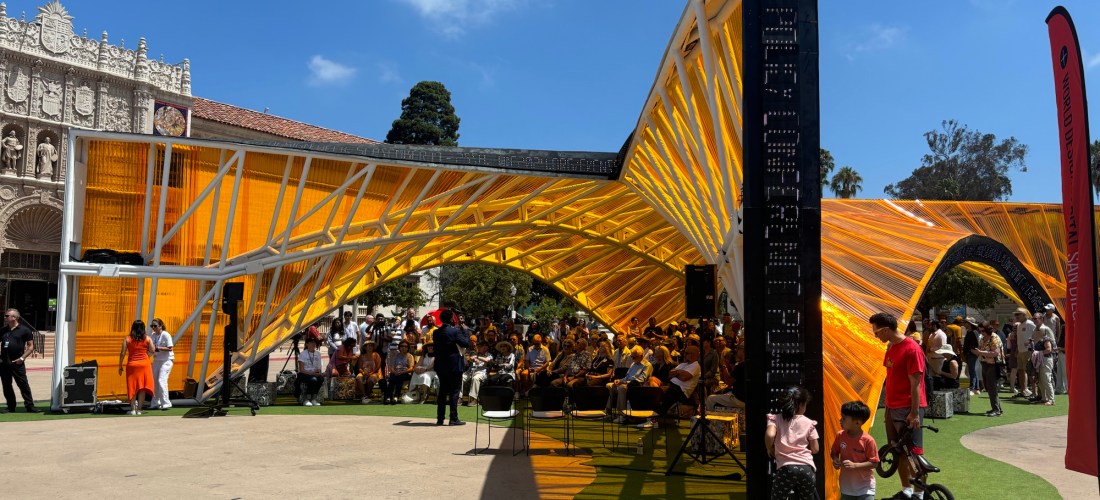
UCSD is leading our region in design thinking, and its Park/Market facility is our region’s design creativity Hub. It’s the center of our WDC2024. We’re fortunate to have both coincide today.

When debating NIMBYs, I like to say that a community’s “character” is found in its memory (history) and expectation (vision). This idea of an International (USA/MEX) Building Expo center is a great idea and we have a history of success with it. Now we are able to ideate a new vision for our region during WDC2024 and beyond. It’s a character defining moment!

And I wish to carry this idea through the WDC year as one of its on-going legacy goals. #LFGSD!

That Feeling of being at Home…

Urban Design

We need to be grounded in that feeling of being around friends and family… Home. Being home is the idea that goes to the heart of what makes food (neighborhoods) great.

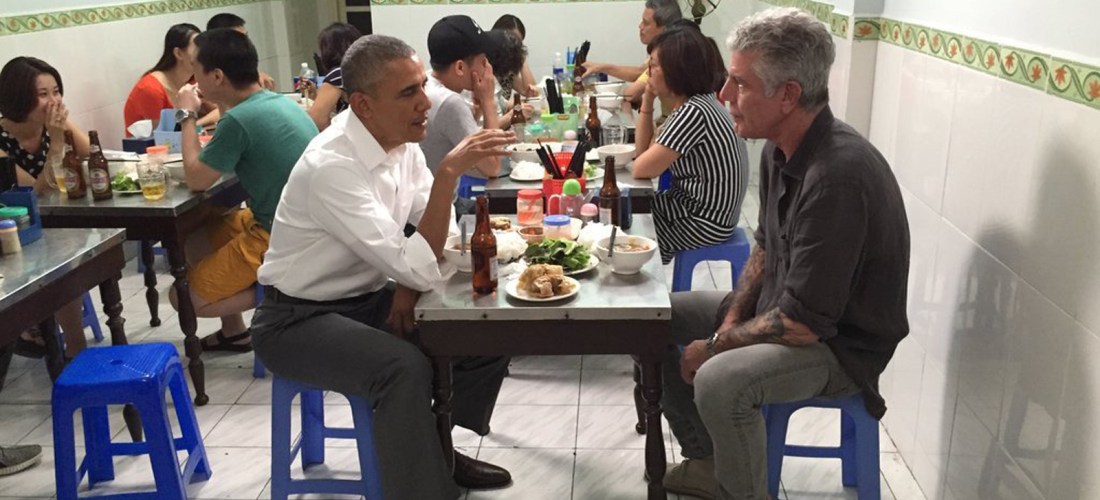
It is an approach to cooking (urban design) that is rooted in respect. Respect for the ingredients (people/places), respect for tradition. It gives the fancy innovations and clever deconstructions a heart and a soul. – Anthony Bourdain, 2008 (Spain – No Reservations)

He said this at the end of an episode describing why the best restaurants in the world were found in Spain. And it encapsulated succinctly how I see urban design, as noted by my parentheses mixed into his quote above. From the intended designed experiences, ingredients and elements to the reliance on traditions for innovation.

The above photo of Anthony and President Obama eating noodles and drinking cold beer in Hanoi reminded me of my time living in Korea and Singapore in the ’90s. I traveled everywhere, designed a few interesting places, and surfed some exotic spots. It was wonderful. But when I was feeling too foreign and out of sorts with everyone around me, I would go eat at McDonald’s, seek out ex-pat friends for beers, and sit down to watch any American football/basketball/baseball game in order to ground myself in that feeling of home.

Dr. Nir Buras, founder of the Classic Planning Institute, says that that familiar ‘sense of place,’ traditional main streets and/or a warm fireplace in winter, is what makes us feel at home somewhere. That feeling engages us emotionally, intellectually, and sensually in a single moment. It is a peak or climax experience that we all tend to experience across our world and cultures when we experience that ‘sense of place’ moment.

The places we inhabit should be purposely arranged and cultivated to bring both the delight of the new and unexpected along with a recognizable structure and traditions to our neighborhoods and homes. Anthony mentioned that too…

The featured Spanish chief in 2008 said he simply wanted to bring joy and order to his guest’s experiences. And to avoid being boring or too serious, because ultimately, we have to be happy.

Especially today.

[Our nation’s old values, attitudes, and prejudices that built our traditions, culture, and homes are being deconstructed today. This is meaningful and healthy, for we can pick and choose what is useful and move forward towards a braver, more just world rather taking the extraordinary risks of having reinventing everything with more failures than successes, especially with most of us living on the razor-thin economic margins. As stated on the Blackson crest, “Do Well, Doubt Not!”]

Innovation Districts… in San Diego?

Innovation Districts, San Diego, Urban Design, Urban Planning

Innovation Districts are a contemporary economic development model focused on geographic areas where medical institutions (Med), research universities (Ed), and technology industry companies (Ted) are purposely clustered and connected with entrepreneurs, start-ups, accelerators, and incubators. These new era economic generators are a market shift from previously isolated suburban research parks towards mixed-use, walkable, amenity-rich places. These Med-Ed-Ted hubs, innovation districts, are useful tools to provide a competitive advantage for large swaths of a city over a single, isolated, private development project.

A question is when is an Innovation Districts more of a big picture policy/vision organizing and fundraising tool or a more refined geographical place defined by its regulatory structure?

THE IDEA DISTRICT – East Village, San Diego

In downtown San Diego, California, Local developers, David Malmuth and Peter Garcia of IDEA1, have identified and marketed their project in East Village as an Innovation District as an ‘education corridor’ from Balboa Park to Petco Park. These types of districts are well documented by urban scholar Bruce Katz here in 2016 and 2019. And a great model of success is found in San Francisco’s Mission Bay, one of the 20 or so of successful innovation districts across the nation.

Innovation District success is found, as Mr. Katz has written, “… in their complexity and integration of what was previously separated and ‘siloed’— people, quality of place, and innovation.” One of San Francisco’s Mission Bay accomplishments is found in its governance, which is evolving from the alignment of strategies and tenants to more sophisticated interventions around place-making. Another of its successes is found in attracting anchor companies, such as Dropbox in Mission Bay, as well as Quicken Loans in Detroit, Comcast in Philadelphia, and Amazon in Seattle’s South Lake Union.

Important urban design elements listed by Mr. Katz include providing a platform for various activities. This means its jobs and work, R&D and education, the arts and transportation. This variety provides the necessary critical mass to support each other. Scientist and creatives, teachers and residents, artists and employees, entrepreneurs and students. The scale and intensity cultivate an ‘eco-system’ that grows innovation and creativity that competes from the local to national scales. These plug into the existing economic infrastructure and governance, which infuse it with civic champions, business entrepreneurs, and leadership. And, finally, Mr. Katz says these big moves led to many small wonders that creates interest and complexity to what is replacing the conventional Class A Business Park model.

While the education anchors (City College and UCSD International Studies) are found in San Diego’s East Village today, it lacks a few of the key ingredients listed above to form a successful Innovation District. Importantly, an important portion of downtown’s governance is transitioning from Civic San Diego to the City of San Diego Development Services Department (DSD) with Civic San Diego still retaining some its economic development functions, such as Tax Credits, but losing its planning, permitting, and parking district oversight.

While a very real shift with intended and unintended consequences, this change appears to be an opportunity to better align the city’s planning/permitting of private property with its traffic, transportation and parks duties. Historically, these services have been ‘siloed’ and this shift might be an opportunity to better align the implementation of the Downtown Mobility Plan with new projects being entitled in East Village to craft a distinctive Innovation District to strategically attract anchor company tenants.

The City of San Diego’s Economic Development Department, and local Non-Government Organizations, the Economic Development Corporation (EDC) and Downtown Partnership, provide incentive programs for new businesses to locate downtown. And, this may be an opportune time to advocate for a dedicated Innovative District with additional incentives and municipal services available to private development, possibly via a Joint Power Authority consisting of a combination of City of San Diego Economic Development Department (Christina Bibler), EDC (Mark Cafferty), Civic San Diego (Andrew Phillips), SD City College (Ricky Shabazz), UC San Diego (Mary Walshok), and California State University (Adam Day) agencies, or some other enabling tool post-redevelopment to purposely provide a competitive advantage for East Village over San Diego’s rival innovation hubs across the US West and beyond.

Why Design (still) Matters!

San Diego, Urban Design

I have running dialog (troll) with a pessimistic friend about the value of our jobs and which of us is cumbersome to this world (yes, I’m listening to Rock Hits ’96 on iTunes… it’s Friday afternoon). And, I had been on the losing end of the troll on the value of urban design in the midst of our coastal cities long-standing housing crisis. His contemporary point is that designing for highest and best use raises existing land values and because everything is already too expensive good design is framed today as an agent of gentrification, and something to avoid.

Times have changed. My past assumptions are regularly challenged in this early 21-century new socio-political context. And, in my circle (social class) of friends and colleagues, I see increasing anxiety as we feel left behind economically and ‘good design’ is only valued by the wealthy to create investor opportunities. See, I was losing!

Searching, I found this terrific article on What makes a beautiful place, by Tristan Cleveland, a researcher at Happy City. And his point on the value of beauty beautifully translated to my points on the value of urban design, which I’ve restated from Mr. Cleveland’s brilliant prose with the following turn:

At the human scale: Design makes a difference in our lives by helping us feel safe and comfortable while walking and socializing in our neighborhoods, which helps us feel happier and experience a deeper sense of belonging to places and people.

And,

At the city scale: Design makes a difference in enabling cities to more easily attract and retain residents and businesses with inviting public streets, civic spaces, and interesting places. Well-designed places are a practical and essential way to bring vitality and dignity to city living.

I think I’m winning… what do you think?

Only as Rapid as the Traffic it's stuck with.

A Better Transit Network in San Diego

Climate Action Plan, San Diego, Transit, Urban Design

(Original Post: https://sandiego.urbdezine.com/2019/01/26/walkable-transit-san-diego/)

At last week’s State of the City address, San Diego Mayor Kevin Faulconer enthusiastically stated, “I want to radically overhaul the system itself. The bureaucracy has been set up to empower anti-housing forces that delay or deny projects at every tum… We need to build more housing near employment centers and transit.”

This is a rejection of our long-standing, auto-oriented, one-size-fits-all approach to city making. Fortunately, in 2008, our City of Villages plan began to shift the standards of new construction of private development from single-family, single-use land use outcomes towards more mixed-use buildings and blocks filled with offices, shops, affordable housing, and market-rate homes. This proclamation officially transitions San Diego from focusing on suburban outcomes, as we have for the past 60+ years, to building within our urban neighborhoods.

Now it’s time to do the same for our transit services.

With the Mayor’s emphasis on using transit to connect our employment centers to new housing construction, it is time to shift our transit modes from its one-size-fits-all, over-reliance on Light Rail Transit (LRT – The Trolley) to a mix of transit modes. The problem today is that our Trolley acts like Commuter Rail by linking downtown to Santee and the border, as well as acting like a Streetcar by linking downtown’s Little Italy to Gaslamp. No matter where it is in the city, the trolley stops every 15 minutes at over 56 stations. Plus, it is limited in its ability to climb hillsides to access and serve the neighborhoods and districts located on our mesas.

With its one-size-fits-all use, our Trolley does not really perform to its fullest LRT function, nor is it capable of being a true Bus Rapid Transit (BRT) or Streetcar. LRT is a fixed-rail system intended to serve city-to-city, such as connecting Chula Vista to La Mesa to Santee. BRT is intended to serve community-to-community, such as North Park to City Heights to Rolando. And, Streetcars are intended to serve neighborhood center to neighborhood center within each community, such as from North Park’s 30th street from Adams Avenue to Upas.

Our city’s new Rapid Bus service is essentially an Express Bus, or BRT-Lite, that flows with traffic, stopping at streetlights, and merging with all traffic on the freeways with 15-minute waits between buses. We do have a short segment of BRT, but it is located on a half-mile stretch on Park Boulevard in Hillcrest. And, we have one historic Streetcar circling a downtown loop on our LRT tracks. These limited modes are our best opportunity to quickly expand access to our city with cheaper and lighter forms of transit.

We need a mixed-modal, walkable to/from transit network to compete with the auto-oriented infrastructure we’ve built over the past 60+ years. It is easier to drive a car around than to take transit because we purposely designed and invested to do. San Diego needs to add BRT on major corridors and local neighborhood Streetcars to connect our mix of surface street buses and fixed rail trolley network.

Since 2013, San Diego has been a member city of the National Association of City Transportation Officials (NACTO), who state in their Transit Street Design Guide (Island Press, 2016, page 178)  “Cities with both buses and a dedicated right-of-way rail system (LRT) have historically structured the former (bus) as a feeder service to the latter (LRT). Bus Rapid Transit can be used to upgrade new parts of the network into trunklines… Streetcars and Buses can also form a multi-hub network.” Just last month the City of San Diego’s Development Services Department stated that it, “is allowing the incorporation of NACTO design concepts as presented in the Urban Street Design Guide (Island Press, 2013),” to plan and design projects. These new rules will permit more dedicated BRT and Streetcar lines throughout the city.

The hierarchy of San Diego’s full-range of public transit service modes are as follows:

  • Heavy Rail (Amtrak) – Connects San Diego to Los Angeles and the nation a few times a day;
  • Commuter Rail (Coaster) – Connects three coastal cities at peak hour times;
  • Light Rail (Trolley + Sprinter) – Connects Santee, San Ysidro to San Diego (with a new line up to University City next year) and Oceanside, San Marcos to Escondido with frequent stops every half-mile or more. Our bus networks feeds into our main LRT lines;
  • Bus Rapid Transit – Easily retrofitted into our wide streets with dedicated bus lanes, separated from traffic, and given priority at intersections to be competitive timewise with local car trips. These connect our canyons (Mission Valley) to our mesas (Clairemont Mesa and Rolando);
  • Express Bus (Rapid & Breeze) – These run faster schedule by not making as many stops as than normal bus services between the same two commuter or destination points on quicker routes;
  • Local Bus – The bulk of our transit service with stops every quarter-mile throughout the city;
  • Streetcars – Modern and historic cars that run on rails that usually flows with traffic on main streets and connects neighborhood to neighborhood;
  • Shuttles (Paratransit, Flex & Lift) – Connects people with daily service and those of us with physical, cognitive, and visual disabilities throughout the city.

The hierarchy of San Diego’s full-range of private mobility modes are as follows:

  • Shuttles (Airport Shuttles, Van Share) – Connects people with daily service and those of us with physical, cognitive, and visual disabilities throughout the city.
  • Bicycles & Jitney facilities – Connects people up to three to five miles comfortably at a slower speed;
  • Pedestrians & scooter facilities – Connect us up to a quarter to half mile distance at a walkable pace.

To support our Mayor’s vision for San Diego, we need to build a more sustainable transit network that focuses on connecting job centers to neighborhood centers with BRT and interconnecting Streetcar lines. Our zoning requires our new housing to be constructed as mixed-use and accessible by pedestrians. The new BRT study investment our City Councilmembers, Georgette Gomez and Chris Ward, announced this week is the right start to building the right mix of transit types to connect new housing with job centers.