Climate Adaptation – Wildfire

Climate Action Plan

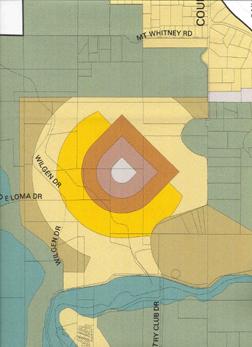
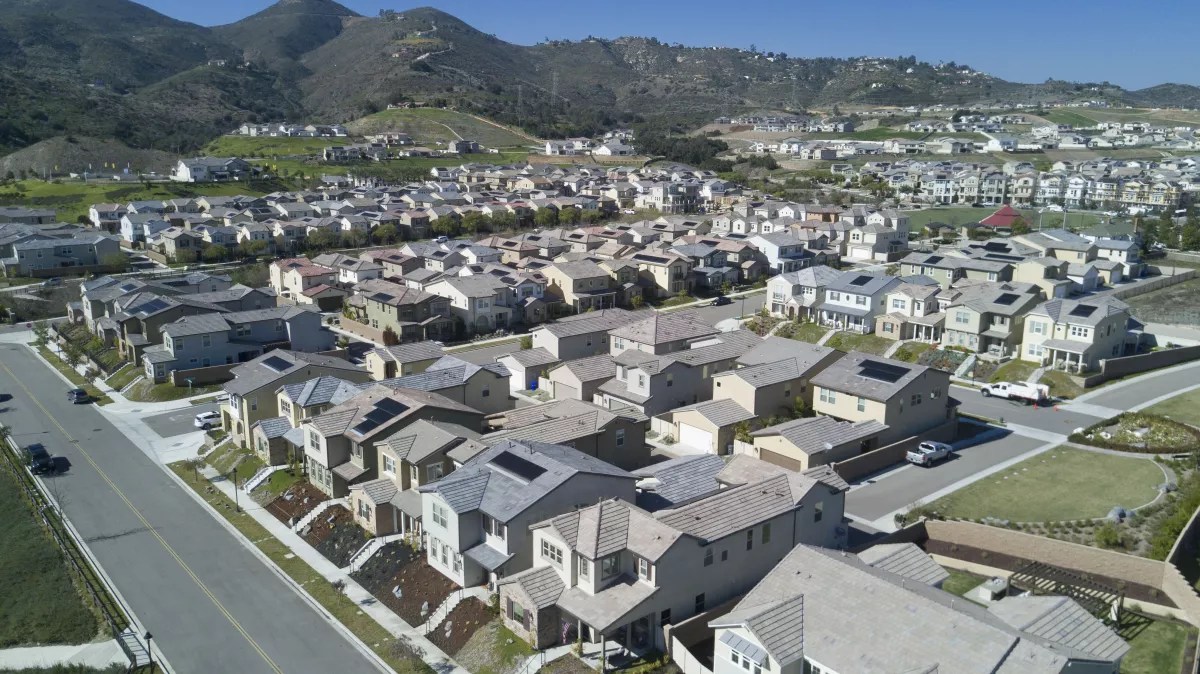
In 2002 – 2003, north county San Diego’s Harmony Grove was a chicken ranch that was closing due to Newcastle disease and would vacate 350-acres on the edges of Escondido and San Marcos. It is highly prone to Santa Ana wildfires traveling up the Elfin Forest’s Escondido Creek valley, from west to east. In 1996, a terrible fire roared up the valley and local residents were willing to trade a new well-connected, compact community, with homes on small lots, parks, and future shops with two roads in/out in case of wildfire, for the vacant chicken ranch. What they opposed was large-lot suburban sprawl on the hillsides that was more susceptible wildfire.

Working as a Project Manager on the General Plan update for the County of San Diego, we designed and entitled a village center, home of a new fire station. And we followed this wildfire adaptation audit process to harden the urban/wildfire edge by building with enhanced fire-safe codes, overlapping zones of defense around clustered compounds, enable firefighting from the roadway. Make space for wildland firefighting (no new sprawl) and structure firefighting in clustered compounds. 

The only step missing is the administrative or by-right development process that fits into the original village plan. The images below are of our initial workshops with the community to envision what should be built and where, the diagrams and plans, and what’s there today, 20+ years later:

(from Fire Mitigation in the Wildland Urban Interface, Martin Dreiling, https://transect.org/modules.html)

Whatever...

One Size Fits One… (and it’s the worst one)

Transit, Urban Design, Urban Planning, walkability

The ubiquitous space, shape, but highly volatile speed of the car is much larger and faster than the universal space, shape, and speed of a human. Yet we continue, since post WW2, design and build everything and everywhere for space, shape, and volatile speed of the car. Streets widen, ground floors are parking lots, people are pushed towards the edges, and cars dominate our landscape. This is what ruins downtowns and isolates small towns. Cars are a suburban mobility tool.

That’s not say we need to ban cars. They do somethings great, such as get lumber, while not as good at others, such as exercising. The fact is that cars are best served for disparate suburban expanses. Walking, transit/buses, and bicycles work best in more urban areas. Cars work great in shorter-commutes and throughout suburbia. Trains, airplanes, and ships work best for long commutes.

The New Urbanism was new because it worked to humanize the car in cities, small towns, and new towns. We’re now moving into the Next Urbanism (and I write about this throughout this blog and speak about on podcasts, such as Kevin Klinkenberg’s Messy City). And as humans, we should be designing and building everything everywhere to accommodate for humans first, letting the right mobility serve us throughout the spectrum of urban to rural contexts.

Downtowns (regional centers) are marginalized by our 1.5 cars per person maxim (Spend 5-minutes walking around Downtown San Diego). Small towns are isolated by freeway by-passes, which need both regionally accessible cars and local people to be economically viable (think Ramona, Julian, and Jacumba, if in San Diego). The industrial era invention of cars and suburban sprawl go hand-in-hand, the built each other. Unfortunately, both cars and suburbs are inhumane and detrimental to our economy, environment, and cultural cohesion (See Sabre Springs).

The next urbanism means making downtowns less car-oriented, small-towns car-supported, and car-happy suburbia having sub-regional centers that are more urban/humane. This place, a small district in Tempe, AZ, Cul-de-Sac, is an example of the Next Urbanism… building more urban, sub-regional centers in the vast sprawl of suburbs surrounding downtown’s regional center. And, by the way, Opticos Design, Inc. is one our best architecture and coding companies.

Existing Context

A City Hall Worthy of San Diego

Public Space, San Diego, Urban Design

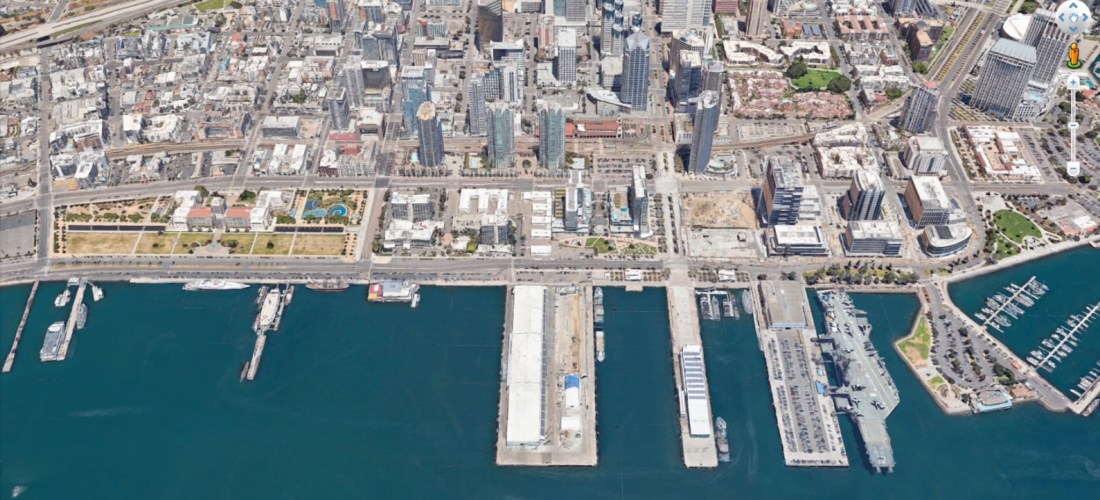
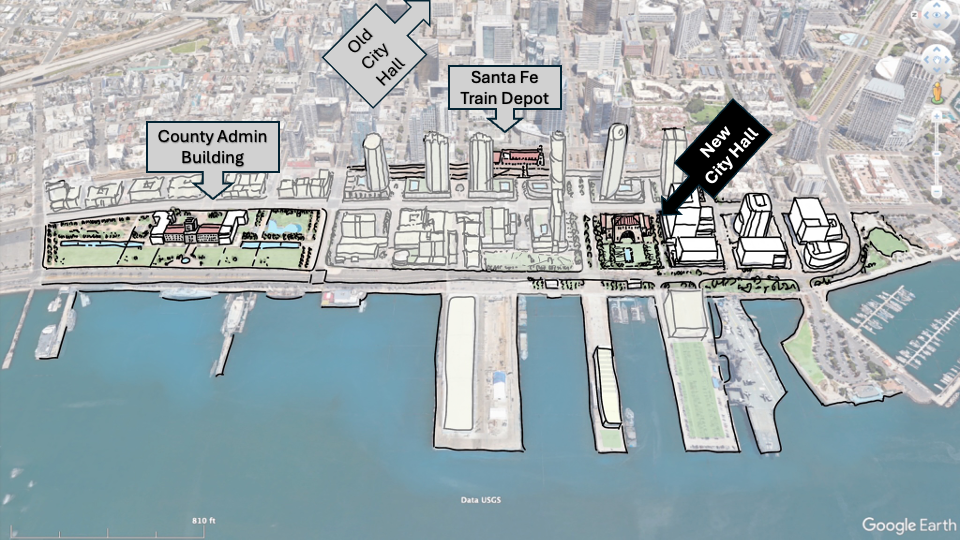
Let’s Rethink City Hall… and put it back on our waterfront! Let’s show our civic pride in reconnecting the city to our great bay! And all of these IQHQ buildings are empty anyway. We can trade Papa Doug Manchester 101 Ash for the Broadway & Harbor block, and build a great and beloved grand City Hall. City can lease the existing buildings for administration/staff offices and everyone, from citizens to staffers, will feel good about going to the bayfront to govern our great city.

San Diego has a history of moving (after burning it down down) city hall, starting in Old Town (burned), then to Market & 5th, Waterfront, and C Street (should be burned), which has never been a beloved place anyway. It too was just a development scheme by C. Arnholt Smith… let’s make it work for us this time.

Our important civic buildings should be located on our best sites, and Broadway & Harbor is that. Use the C Street land sale $$ to build a new Chamber/Hall on our best site. And let’s be proud of how we govern our great city on the bay.

How I Got Here…

Leon Krier, San Diego, Urban Design

First, one of the many reasons I owe Mr. Michael J. Stepner, FAIA, FAICP, more than I can ever repay him is because he helped me find my professional path. My career as a planner started in Honolulu and then San Diego. I remember reading in the newspaper about Mr. Stepner being fired by a crude City Manager, Jack McGory, and then hired back by the city council, who overruled Jack, because he was rightfully leading San Diego towards its mixed-use, walkable, transit-supported future. Mike’s story resonated with me and that he had great credibility.

Second, here’s my new urbanist origin story. I was working for an architecture firm in Daegu, South Korea, during the Asian Tiger economic boom from ’93 – 97. And I found myself designing their first retirement communities using my suburban SoCal drive-thru lifestyle design tools. Traditionally, Korean elderly give their inheritance to their children when they moved in with their children’s family and they lived together in their compound housing (totally different from modern Western civilization tradition). And I designed their first car-oriented ‘silver towns’ because the middle class and car ownership was rising and they had money to put their elderly in homes. I met with the owners and looked into the sad eyes of one of the elderly men in the room who was envisioning his life isolated in a retirement box, alone.

I realized I was destroying a culture and that I had power as a designer and with great power comes great responsibility (credit: Stan Lee). So I knew I needed a deeper understanding of my craft and further my education. So I starting searching…

Around that same time, 1997, I took a job in Singapore to master plan port facilities with housing for imported labor… and none of those cheaper laborers imported had a car. These were exclusively walkable neighborhoods for 1,000s of workers. If the port facility was in Malaysia, they brought in Indian workers, if in the India, the brought in Philippine workers, and so on. Going into the interview, I remembered reading about Mike Stepner designing walkable, transit-station areas in San Diego and hiring Peter Calthorpe. So I bought Peter’s book, The Next American Metropolis, read it on the 30+ hour flight, copied his drawings into my notebook that I showed at the interview and got the job.

In Singapore, I found an older Calthorpe and Sim Van der Ryn book (’91), Sustainable Communities, and on the last two pages, they reference Leon Krier as the future guru of planning sustainable communities. Of course Leon is the godfather of the Congress for the New Urbanism because he taught at Yale when Peter, Andres Duany, Liz Plater-Zyberk, Stefanos Polyzoides, and Andrew Malick’s father were students there. And down I went, into the Leon Krier rabbit hole. Amazingly, within my own profession, I found the innately humane power in building walkable places that people loved. And it energized my career.

Unfortunately, in ’98 my father passed away but it left me enough money to go get my Masters in London (Univ. of Westminster, ’00) and put money down on a house in San Diego (’01). I went to London specifically to learn from Leon as I interned with the Prince’s Foundation, but I didn’t get to meet Leon…

Returning to San Diego, I worked on the County of SD General Plan Update and I’m asked by an NU colleague to go on a charrette in Chico, CA (’04), led by Leon Krier! My boss said I couldn’t take the time off to go so I quit the County and went (they hired me back as they didn’t expect me to quit). I purposely watched Leon and immediately sat at the same table as him, along with Geoff Dyer, who’d become my business partner and dearest friend. We sat there, stole scraps of drawings, listened, learned, copied, and soaked in the charrette that was a beautiful mess. Leon knew my London teachers and Princes Foundation colleagues and we became friends.

From there, Leon and I spent time together at New Urbanism’s annual Congresses. And when his book, The Architecture of Community, came out, he came to San Diego to lecture in Balboa Park, and we packed the Photograph Museum theater to the rafters, which was real meaningful to Leon at that time. He came back again a couple other times and together we drove my convertible Porsche across the desert for him to lecture at Univ. of Arizona. A memorable moment at one of his lectures in the NewSchool of Architecture, he asked the audience if anyone in the room had ever designed a tower… and in the front row, only Frank Wolden raised his hand!

We were able to spent a lot of time together then and during Covid, when he was trapped in his Cayala, Guatemala, studio for several months, we recorded these vlogs (and here) to talk about design, history, philosophy, and beyond.

And while in San Diego, he’s come up some of his more recent ideas that he’s published and we continue email debates on topics/issues, such as Corbu/Speer and vertical transects. His design idea for Coronado’s toll booth landing area is brilliant, using different height columns in a circle appear to ‘move’ when driving across the curve of the Coronado Bridge. 3-dimensional thinking. Here and here are a couple of links on his visits to San Diego.

San Diego/Tijuana is a World Design Capital

San Diego, Urban Design

This is an excellent article about the need for design innovation in SoCal, and very apropos to San Diego. In short, the author explores ideas about the need to ween ourselves off of our car culture and recommends Building Expositions: Design thinking is applied to urban design through rapid urban prototyping, and as such through the primary tried and proven vehicle of international building exhibitions, which have had a successful track record for more than a century.

San Diego/Tijuana has a history of important building innovations, starting with San Diego’s two early 20th century world expositions. First with the invention of Spanish Revival in 1915 by Bertrand Goodhue, and then with suburban sprawl in 1935 by the Federal Housing Authority. The suburban auto-oriented pattern of building was first exhibited in ’35’s FHA suburban model homes by Neurta and Eckbo, and it changed the world.

In the 1950s, San Diego also invented Climate Change (Scripps GhG/carbon measurements by Roger Revelle and Charles Keeling), which dramatically changed our world too. We invented the modern LRT system, Transit-Oriented Development (Peter Calthorpe/Mike Stepner), modern ranchette house (Cliff May), modernist tilt-up construction (Irving Gill), Salk Institute (Lou Kahn), downtown urban malls (Jon Jerde/Frank Wolden), and we have UCSD’s Teddy Cruz’s study on cross-border construction techniques found nowhere else. Our latest UCSD/Tijuana Migrant Shelter (Teddy Cruz/Fonna Forman) and Cross-Border Terminal (Ricardo Legorreta/Blackson – yeah, I did the Site Plan) are important innovations too. Our bordering cities have a successful history of building innovation that needs to be celebrated.

This is the value of next year’s WDC2024. The World Design Capital is a legacy thread that builds upon our history of innovation and has the potential to reshape our future.

Buildings are spaces and places we inhabit as humans. Virtual Realities, Artificial Intelligence, and Autonomous Vehicles are appropriately named… they’re fake, false, impersonal, and limited. Salk/UCSD’s CAVE has faded after so much bluster in 2007, but is an early 3D/VR innovation, and something to be proud of. We need to build them to test our 21st century spaces and places, and share the risk/financing/rewards. For example, a heavy timber building was quietly built and successfully earthquake tested recently at UCSD. We need to test/build modular as well as Doug Austin’s concrete prefab patent idea. We need a place to share this knowledge and get onto our less suburban, auto-oriented future our climate and society demand.

UCSD is leading our region in design thinking, and its Park/Market facility is our region’s design creativity Hub. It’s the center of our WDC2024. We’re fortunate to have both coincide today.

When debating NIMBYs, I like to say that a community’s “character” is found in its memory (history) and expectation (vision). This idea of an International (USA/MEX) Building Expo center is a great idea and we have a history of success with it. Now we are able to ideate a new vision for our region during WDC2024 and beyond. It’s a character defining moment!

And I wish to carry this idea through the WDC year as one of its on-going legacy goals. #LFGSD!

On the Perception of Safety, Density, and Other Voice of San Diego Articles… Plus a New Urban Film Fest!

Urban Design

Last week I wrote this article on Urban Design and our sense of safety and place that was well read.

And, a few months ago I wrote this article on density that is in this blog somewhere else, but I wanted to let Voice of San Diego know that I appreciated their willingness to let me share my professional perspective on how to make San Diego a great city.

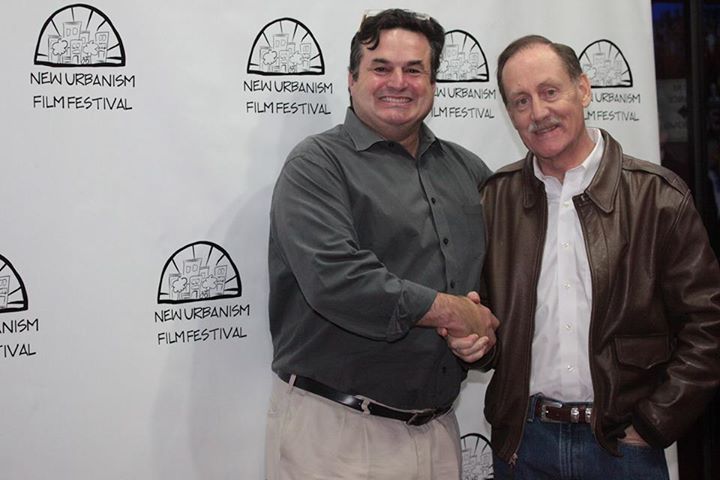
And, this week is the New Urban Film Festival at the ACME Theater in Hollywood. Tomorrow is our CNU-California Chapter Annual Meeting and Award presentations. Last year, City of Santa Monica City Manager Rick Cole won our annual Paul Crawford Award. This year, we awarded it to Sustainable Transportation Guru, Jeffrey Tumlin, and honored the work of the Local Governments Commission. Hope some of you can join us tomorrow for the presentation. Cheers!

“San Diego Urban Planning !”… now go wash your mouth out with soap.

Urban Design, Urban Planning

“A fundamental aspect of planning…is the disjuncture between individual rationality and collective rationality. […] In certain situations, individual preferences aggregated to a societal level produce illogical or undesirable outcomes, including rubber-necking delays on highways and hockey players’ reluctance to wear helmets. In such situations, if the group made a decision as a whole, it would be far different from the sum of the individual decisions of the members. In a market-oriented economy, planning’s reason for being is fundamentally tied to this disjunction between individual rationality and collective rationality.* 

Isn’t that the role of planning in governing our cities, mediating short-term, long-term, and emergency decisions? Having a plan limits and manages risk in the market place by providing the vision, codes, and certainty to the legal entitlement process and economic responses to building the city. City building innovations and managing their risk set the baseline economic value for the market to respond to. Managing these elements is our city’s planning department’s policy and regulatory responsibility.

However, because creating a vision and then coding that vision is an iterative public and political process, the collective preference is usually at odds with the individual… be it the “no-change neighbor” or the “starry-eyed developer.” In the end, the built results illustrate the values of what our ‘group decision.’ We can drive along Harbor Drive to see the results of what San Diego collectively values over time (hotels, convention center, baseball parks, and other economic silver bullets).

I’ve previously written about Urban Design and Planning’s precarious position between a rock and a hard place in the City of San Diego here. After coffee last week with Michael Stepner, FAIA, FAICP, we came to the conclusion that San Diego’s planning history is actually a culture of trying to “get out of the way”. Our city leadership will support planning in good times, but then we are just as supportive of throwing it out in bad times. Mike‘s opinion was formed by seeing several iterations of its rise and demise over his award-winning career.
Stepner Experiencing a Re-Organization of Planning (image: MStepner)

Stepner Experiencing a Re-Organization of Planning (image: MStepner)

My opinion of our planning-as-little-as-possible approach is formed by empirical observation and review of San Diego’s historical planning documents, and their negative connotations. Kevin Lynch and Donald Appleyard gave us, A Temporary Paradise?, with its title illustrating that San Diego is missing its opportunity to take advantage of our cultural and natural assets (canyons, border, bay). Plus, we started planning in 1908 with John Nolen stating upfront, “Notwithstanding its advantages of situation, climate, and scenery, San Diego is to-day neither interesting nor beautiful. Its city plan is not thoughtful, but on the contrary, ignorant and wasteful.” I get it.

We are still having a hard time with planning today as needed Community Plan Updates go through referendums and delays. Transit-Station Areas plans turn into protesting mobs fearful of 60-foot tall ‘towers of terror!’ And, add in the fact that two nationally-recognized urban planning / smart growth gurus, Bill Fulton and Bill Anderson, were un-ceremonially relieved of their planning director’s duties, its time for cultural shift of planning expectations here. That said, I am very fond of local planner, Jeff Murphy, and am pleased he accepted the director position this week.

Canadian planning director rock stars, Brent Toderian (Vancouver) and Jennifer Kasmit (Toronto), both recently stated that “Planning Directors need to be truth tellers.” Telling the truth builds trust, and it is trust that is lacking between San Diego and its professional planners. Our profession has historically been vilified as consultants to evil developers, administrators of wasteful regulations, and stooges for unjust political agendas. I get it. 

Part of our cultural problem with planning is that in good economic times, San Diego historically tends to value planning as a tool to slow or mollify development spikes. For when money is flowing, it floods our city. And, in bad times, we eliminated planning for it then gets in the way of continues to slows any new building, because thats how it had been used before the sudden crash. 

Therefore, we need to learn how to use planning as tool to guide our city buildings, and providing public services as well as limit private investment risks, in both good times and bad. This change will take a cultural shift, and it takes time cultivate culture. The following points are how I think we can start this shift:

REALLY LEARN FROM DOWNTOWN

No, I do not mean scatter downtown’s high-design residential towers across the city (we tried that 40 years ago and it got us the 30-foot height limit along the coast). I mean review the tools that changed its culture from a 9-to-5 business district into mixed-use, more walkable urbanity. The tools were a carefully localized zoning tool (its PDO), a defensible environmental document, and a predictable permitting process.

Throughout the rest of San Diego, we have a problem with implementing our big policy documents (General Plan, Community Plans, TOD Guidelines, Climate Action Plan) because we then treat everything at zoning/regulation level with a one-size-fits-all approach. One of downtown’s best lessons is the value of detailed plans and planning at the neighborhood scale. As a matter of fact, today’s Community Plan updates are replacing local PDOs that need to be updated for new city-wide zoning. Downtown should teach us to avoid this approach and try to localize our rules to better limit conflicts between neighbors over details such as how new buildings face onto the street and backs up its neighbor, and the character of that street, from Main Streets to quiet residential streets.
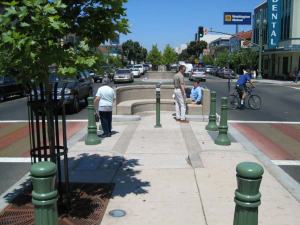
Streets are for cars, people, bikes, shops, homes...

Streets are for cars, people, bikes, shops, homes…

LEADERSHIP NEEDS TO KNOW BEST PLANNING PRACTICES

We need our leadership to discuss where we are going with our city planned. It doesn’t happen in a vacuum. Today, we rely too much on our short-term political leadership to move projects from idea to building permit. And, without enough capacity to equitably provide the same attention to everyone, only a few get this excellent service.

Mr. Stepner reminded me that former Mayoral icon, Pete Wilson, set broad goals and used his professional staff to do their best duty of care to make the right decisions. These decisions use to be based on best practices and national models modified to the local context. Somehow we’ve lost that trust. I recommend our local professional and advocacy groups shift from preaching the choir to directly engaging local political leadership in lectures, workshops, and presentations on best practices from around the world (but don’t lose your 501c3 status).

PLANNING NEEDS TO KNOW BEST PLANNING PRACTICES

Ok, San Diego, we’ve got 1980 suburbia down… We know how to designated the use of a building, disclose its impacts on the environment, measure its Average Daily Trips, calculate the financing needed to build a new traffic signal at the intersection down the street these new trips will drive through, and collect Development Impact Fees for a future park that is expensive to build. While this system works well in a new residential pod out in Rancho del Rancho, it is impossible to use in our older, urban neighborhoods. This partially why our new policy goals mentioned above are difficult to implement. We’re using 20th century tools, such as land-use based zoning, to build a 21st century city. There are 21st century planning tools, such as context-sensitive, form-based, and place-based zoning tools and street typologies, available to make connections between policy and getting the places we want built. 

In our market-oriented economy, we must shift our reluctance to plan towards being a tool that bridges our city’s ongoing disjunction between an individual’s wants and our collective needs.

*National ACIP Examination Preparation Course Guidebook, 2000