Leonardo Divinci's City Plan, "BE COOL."

The #1 Reason for Zoning Reform: People are Obnoxious

Uncategorized

Missing middle housing, and similar ideas of gentle density and incremental housing, are useful tools for cities allow for new homes to be built in existing neighborhoods. This is especially true for older or historic neighborhoods with predominantly low scale, low density, single-family detached homes. These are measured tools that transition long-standing neighborhoods from no-growth to adding more middle/medium scale housing/density/population. These new apartments/attached buildings adds a variety of people at different socioeconomic points of their lives, which smaller and larger units on the same neighborhood block tend to do. And new infill homes add tax revenues to fix old streets, sidewalks, lights, parks, and other civic infrastructure (in concept).

Fortunately the City San Diego’s planning department is starting to reform its zoning. It recently identified and adopted Transit Priority and Sustainable Development Areas. These allow for new projects that include affordable housing to waive its zoning, such as height, setbacks, and density. This is a very smart understanding that our city’s conventional zoning, the rules that regulate the configuration and orientation of a building, are out-of-date and not aligned with today’s housing-at-all-cost priorities. This is a great first step in recognizing that conventional zoning is broken. And for the past decade our state legislature has been pushing cities to allow for more housing and bypass its long-standing zoning rules, which have been rightfully deemed as being in the way of building cheaper, faster housing.

Born from racism and modernism in response to the industrial age, conventional planning and zoning is just a dumb form of segregation by land use. Residential, commercial, and industrial use separation has wasted our time (too many hearings, decision-makers, and gatekeepers), space (suburbia as far as the eye can see), and money (housing scarcity and prices). It is has been in need of reform for decades, but status quo is difficult to change, as well as messing with people’s inherent land values.

As a New Urbanist, I’ve been advocating for Form-Based Codes as code reform for over 25 years. These emphasize the configuration of buildings and places in context and/or form first, such as Main Street buildings on Main Street and rural buildings in rural areas. The function, or land use, of a building and its surroundings, are of a lower priority in Form-Based Codes as mixed-use, walkable urbanism is more complex than making us drive to a pod of work/home/play/shop/worship suburbanism. It is a proactive, rather than restrictive, approach to zoning regulations. And Form-Based Codes (now Objective Design Standards in California) are reforming zoning across the nation, albeit slowly.

Thankfully, the New Urbanism has won the war against suburbia. New housing is mostly in town or extending the town’s boundary on its edge. Rarely do we build new stand-alone subdivisions out by the wastewater plant, over ancient graves, or adjacent to heavy industrial districts, which is a good thing as those are noxious and dangerous places. Today these noxious districts are regulated by State or Federal rules and not local municipal zoning anymore. However, the new Federal administration is pulling the plug on these regulators, so…

Wiser, I see that new housing isn’t being located near those old toxic/noxious places, such as iron smelting or horse melting to make glue – as those industries are now done in other countries – because new homes are mostly being built next to existing homes. This means new housing problems are how their presence creates friction between both new neighbors and with existing residents. In short, as much as we love people and each other… we also really don’t like each other just as much. We live in a world wanting peace and quiet, and rules to keep it that way (see: every religion).

As humans, we understand that we have more public fronts/faces, sides, and more private rears/backyards. We prefer people, that aren’t immediate family, to either face us along a more formal public street or back onto each other with private space/yard or messy service alley. We’re built this way. It is well understood, comfortable, stable, and peaceful. Especially when we respect our western cultural social and physical norms. Bravo’s housewives, “Be cool, don’t be like all uncool,” would probably be a great zoning reform policy.

We also want justice. And when someone else appears to be getting ‘more’ than ourselves or others, it creates a sense of injustice. When one neighbor places a 3x taller building next to low-rise homes, it confuses the home’s fronts and backs as well as land values, which are destabilized with extreme building types sitting adjacent to each other. It creates fiction and conflict between people, not the land uses.

Without building zoning standards, public fronts and private backs are confused. Where are we supposed to be loud, welcome guests at the front door, throw our trash, sit quietly, and put screaming kids to play? Being cool is more than a suggestion… it’s in need of new rules.

Zoning today equates to almost exclusively dealing with obnoxiousness between residents, such front doors looming over backyards and quiet places versus public engagement places. These aren’t noxious issues, such as industry pollution spoiling the land, but more offensive social issues that spoil our previously suburban quality of life (more on that in a later blog), as the want for quiet and dogs/pets in downtowns are a “suburban echo,” and a new expectation for living in urban neighborhoods. Zoning reform needs to focus on these very real issues. The absences of rules only creates unintended conflicts between neighbors.

We need to set boundaries on how to live together. Meaning, we need new zoning rules for obnoxious behaviors rather than 1940 rules for noxious conditions. Sociable neighborhoods start with putting the right range of building types on specific street types with specific park types that help our society get along well. Missing middle housing types are better than towers to fill in older neighborhoods. They create less conflicts while adding lighter, faster, and cheaper homes.

These are simple rules that can be monitored by city (public) planning and development departments while it works towards building better public streets, sidewalks, lights, and parks (public entities doing public stuff), while regulating the simple stuff that we know lends itself to obnoxious behaviors between private developments. Following any good planning strategy, zoning reform starts with understanding today’s context, collaborating to generate a common Vision (making policies that relate to our values and priorities today), then generating a plan and/or code (making regulations), and then making them happen through actions and implement is how we implement zoning reform today. Be cool.

Social Isolation and Sitting to Work are Connected

Uncategorized, Urban Design, Urban Planning

I subscribe to Arnold Schwarzenegger’s fitness newsletter that provides daily content on health and fitness. There was a deep connection that resonated with me in this morning’s newsletter articles. The first was on this study regarding the early mortality rate of those who are lonely and isolated socially in comparison to those who are socially and physically connected to others in their neighborhood, as well as with family and friends. The second story was about the health value of getting up and walking around every hour so rather than sitting for more than 2 hours straight.

In our suburban nation we sit in our cars to go anywhere. We then sit at our desks to do the majority of our work. And we sit at home and watch tv or doom scroll through the bitter end of social media as we once knew it. We sit and drive to sit a lot. And it isolates us from engaging with people on street corners, in public and private places, and at work (we don’t go to church, or social clubs, or the library, or post office anymore). We have transitioned daily need trips, such as picking up milk, eggs (too expensive!), newspaper (what is that?!), and dry cleaning (we don’t wear hard pants anymore) to online shopping that is delivered.

We’ve isolated ourselves in our homes and it has obviously become bad for our physical and mental health. It’s easy to see that we’re not healthier, happer, or wealthier in our new post-industrial, online lifestyle…

So what can we do about it? I recommend following this manifesto: https://www.cnu.org/who-we-are/charter-new-urbanism

Georgia Blackson – Resume

Uncategorized

CONTACT
Georgia Blackson
+1 619-764-0586
Blacksongeorgia1@gmail.com

EDUCATION
MET SCHOOL OF FILM, LONDON
Certificate in filmmaking – [Watch Georgia’s Final Project Film here!]

SAN DIEGO HIGH SCHOOL
Graduated May 2020

Georgia is a hard-working, budding artist with five years of work experience and proven knowledge of food sanitation, safety, production, and sales. Looking forward to a career in film studies but in the meantime aiming to leverage my abilities to successfully fill this supporting role in your business. Frequently praised and adaptable and highly capable by my supervisors, instructors, and peers, I can be relied upon to help your company achieve its goals.

EXPERIENCE

Waitress – Sammy’s Woodfire Pizza, 12925 El Camino Real, San Diego, CA 92130, Jan 2023 – Sep 2023 [Contact: Front Office, (619)484-4626]

Salesperson – The French Gourmet, 960 Turquoise St, San Diego, CA, Sept 2022 – January 2023 [Contact: Jennifer Slunderlan, (858)488-1725]

Salesperson – Hot Spot, Liberty Station, San Diego, CA, Aug 2021 – Aug 2022 [Contact: Marley Smith, (619)453-6474]

Hostess – The Big Kitchen Cafe, San Diego, CA, Feb 2019- July 2021 [Contact: Judy the Beauty, (619)750-2357]

VOLUNTEER

San Diego Civic Youth Ballet, Dance Instructor Danika Pramik-Holdaway, Director, (619)233-3060 Student Instructor for “Ballet for Me”, a ballet class for students with a range of disabilities.

Rachel’ House, Roselle Ellison, (619) 279-6379/dirkandroselle.ellison@gmail.com. Volunteer food server at Rachel’s House, a women’s homeless shelter in downtown San Diego.

Self-organized and participated in neighborhood and beach clean-ups throughout San Diego County.

The State of Land Policy in America

Uncategorized

Recently, the Lincoln Institute asked readers to submit their best definitions of land policy. Being late, I offer the following that builds upon their submissions for your consideration:

Land policy is the rules and regulations that govern the use, ownership, and management of urban and rural lands. It involves both rational and emotional decisions about how the federal, state, and local authorities determine land uses, who are allowed to access to it, and what activities are permitted on it. These policies trend with our collective social consciousness between individual property rights and common public good at both national and local levels.

Land policy has both formal and informal outputs. Formal outputs are often plans, regulations, and programs. Informal outputs are often socially accepted patterns that shape our underlying cultural behaviors and social expectations. However, as stated in my previous blog, the federal, state, local land use policies are as misaligned as our current social and cultural malaise.

The study of land policy was founded during the early 20th century’s Progressive Era in response to economically and environmental instability generated by industrialization’s overwhelming amount of poverty and pollution. The rising tide of the new industrial age/era wealth was expected to lift all ships, but apparently only the steel hulled ones stayed afloat. As JP Morgan, Carnegie, and Vanderbilt’s robber baron class drove our lassiez-faire economic policies towards violent race and class warfare during in the Reconstruction Era that led to the reactionary, government led Progressive Era.

Land policies led to the establishment of local zoning controls in the 1930s/40’s. Then in the 50s/60s it was focused on urban renewal, and then environmental conservation in 60s/70s. In the 80s/90s it concentrated on redevelopment and economics. In our 21st century, it is focused on housing and social equity as our economy has again dramatically shifted, from industry to knowledge-based products.

And so here we are again today, wrestling with lassiez-faire Republicans supported by capitalist oligarchs’ whose exploitative practices influence our highest levels of government policies and manipulate our media markets. They form monopolies to raise prices, pay subsistence wages, and exert control over natural and public resources to amass extraordinary wealth. And our current Democratic-led social justice and equity era is echoing the Progressive Era’s renegotiation of social norms in the face of violent white, Christian nationalism… Ugh.

The GOP-led oligarchy system is being confused for authoritarianism. They’re not taking control; they’re abandoning the role of the government owning and managing the public good in trade for individual wealth creation. This is the state of Land Policy today…. the waiving of housing regulations while blocking the reformation of public housing to promote a supplyside, trickle-down response to chronic coastal city housing shortages. The focus on enabling regulatory-free development in transit areas policies without investing in transit supported infrastructure. And in economically static rust belt cities, nonprofits are expected to fill the void and role of both private development and public investments… Gah!

We’re experiencing a new land policy era in real time. North American cities continue to transition towards more human-scale urban development patterns in our post-industrial society, and even more rapidly post-pandemic. And our land policy should be leading cities and neighborhoods towards economic, environmental, and social equilibrium and away from the predominantly individual interests over our collective needs… C’mon.

Town Planning, the Basics…

Uncategorized

Town Planning involves processes undertaken by municipal planning departments to visualize, plan for, coordinate, and act on the three-dimensional physical layout of the town. This includes the zoning of different areas for various uses, such as residential, commercial, and office spaces. It also includes the subdivision of public property and the creation of public streets and park spaces. In addition, it takes into consideration the economic, transportation, political, legal, environmental, utility and sanitation infrastructures.

The goal of town planning is to achieve a desired urban form and to ensure that a certain level of accessibility, walkability, adaptability, efficiency, and economy are built in and adapted to over time. The public streets and spaces provide the long-term structure for building a town, and private development provides the day-to-day life within this framework is allowed to change and adapt as needed.

Today, town planning discussion have been dominated by zoning, the regulation of private property. However, this focus on zoning can sometimes overlook the more permanent and important patterns of subdivision, which involve the ordering of public and private property. Therefore, the challenge in town planning is to balance these two domains of zoning and subdivision to create a town that is healthy, safe, and welfare-promoting.

Basic Town Planning Elements Involves:
• Development Patterns – Suburban to Urban Street/Block Types
• Public and Private Spaces and Buildings – Location and Scale
• Planning Types – from the Region to the Lot
• Place Types – from Pristine Nature to the Town Center
• Character – From Memory to Expectations

(yeah, I used The Doug Allen Institute Chatbot to help me write this: https://app.docuchat.io/chat/48e19f7e-4aa5-4148-aed3-4be829e4c241)

Streets are Mixed Use too…

Uncategorized

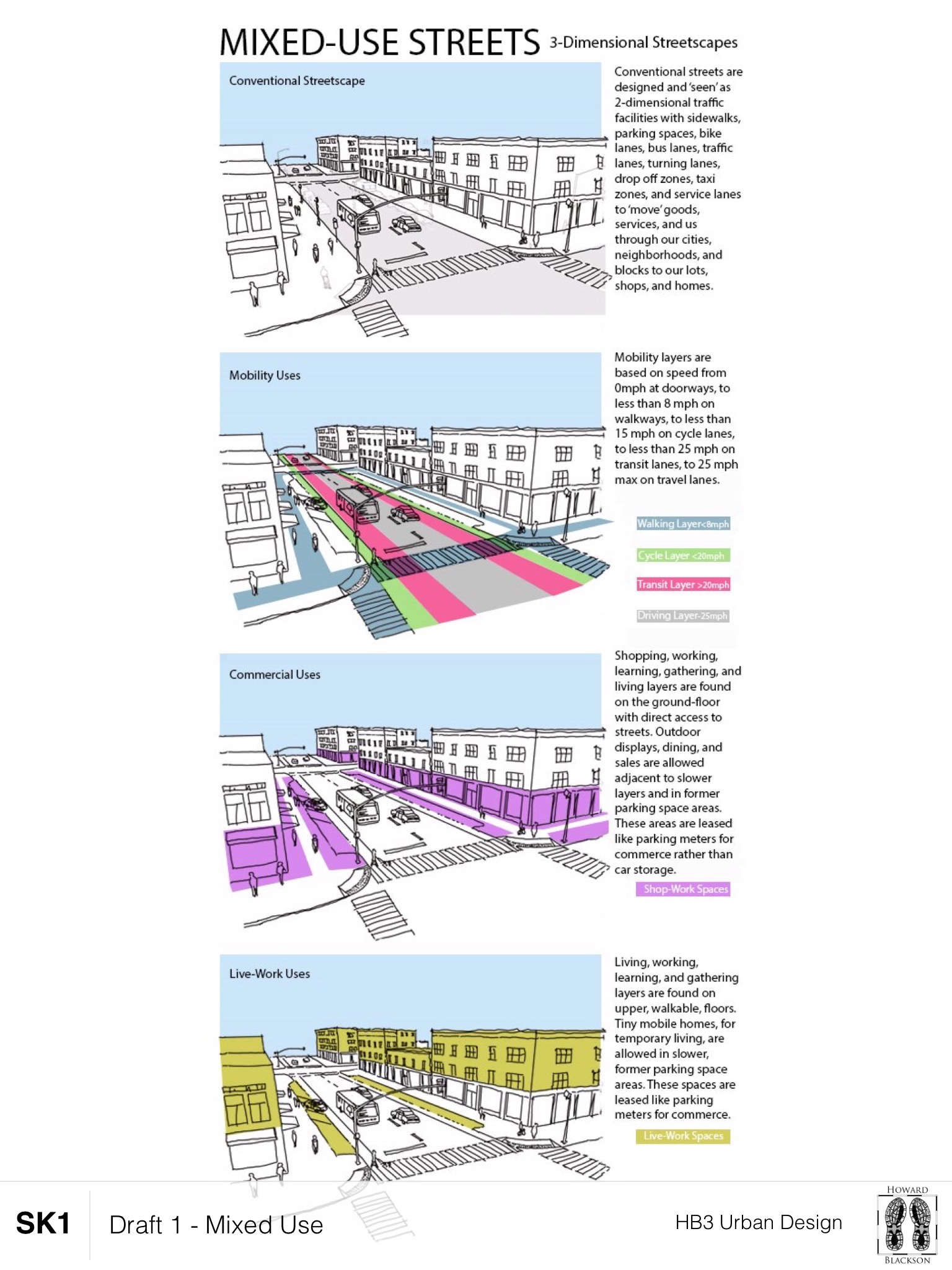
Streets have a mix of uses. Streets needs to be viewed in terms of a series of layered uses and speeds and be designed appropriately in relationship to the buildings that front onto the streets. The following are a list of uses per layer from building edge to centerline:

1) Ground floor Layer – The building fronting onto the street. Hold long-term Commercial, Residential, and Civic uses.

2) Encroachment Layer – Holds signs, less than public seating, dining, displays, deliveries, doorway zones. Holds more longer-term Commercial, Residential and Civic uses.

3) The Sidewalk Layer – <5 mph pedestrian travel lane with walkway, ADA access, on a clear path.

4) Furnishing Layer – Street Tree planters, more public seating, street lights, signage, parking meters, newspaper stands. Holds longer-term Commerce uses.

5) Parking Layer – Public parking stalls (angled/parallel/perpendicular/reverse angle), painted stripes, handicap stalls, transit stops, loading/commercial zones, drop off/delivery, and short/long-term car storage. Holds more shorter-term Commercial, Industrial, and Residence uses.

6) Cycle Layer – <10 mph zone between stopped parking cars and transit/travel lanes for various cycles ridden by various aged people.

7) Transit Layer – <25 mph zone between pulling in/out of Parking Layer and into the Driving travel through lane(s).

8) Driving Travel Layer – <25 mph zone (because any more than that kills most people)

All of these layers are mostly interchangeable and not every element is on every street. The big idea here is to introduce to the Furnishing and Parking Layers permanent Parklets, and movable/temporary Tiny Mobile Units in place of private car storage. These facilities can be rented and used for metered time periods as shops, hotel, and short-term residences. This is a shorter than permanent building Live-Work mix of uses that sit in the public right-of-way and reclaim the street from primarily auto flow use to a more livable and complex area that prioritizes the speed and scale of people. The image is an unfinished draft.

A forthcoming Mixed-Use Street PROPENSITY Map will illustrate where the more to less mix of uses on the streets are located. Think of it like a land use plan map for our streets. And, finally, for cities and places with overly scaled streetscapes, this is a way to reclaim public space for private commerce and housing (some public). A link to the ratio of public to private space discussion is here. What do you think?

Reforming Government to End Systematic Racism

Uncategorized, Urban Planning

An answer to our demands to end systematic racism will be found in reforming our role and structure of governance. Rick Cole, former Santa Monica City Manager, made some solid points about how our government system of today is a turn of the 20th century Progressive Era construct, a response to industrialization, in an era of racism. Racism was prevalent throughout that political movement comprising mostly white, small-town, Progressive voters grabbed the reins of power from business elites, government anti-trust policies shifting power from the elite robber barons.

As Thomas Leonard writes in, Illiberal Reformers, Princeton University Press, 2016, “The industrial revolution and the rise of big business after 1870 dramatically increased American living standards, but the era was plagued by recurring financial crises, violent labor conflicts, and two deep economic contractions. In response, progressive economists sought to regulate the American economy through a new administrative state based on scientific management principles. They established economics as an academic discipline, while promoting and helping build regulatory and independent institutions such as the Federal Reserve (1913), the Federal Trade Commission (1914), and the International Trade Commission (1916).

Unfortunately, their policies were based on social Darwinism and eugenics and excluded groups deemed inferior — including women, Southern- and Eastern-European immigrants, Catholics, Jews, and blacks.”

Red Lining and resulting zoning were born from that era, which I have spent a career focusing on reforming. However, I only just now realized that this advocacy for zoning reform was a very limited view and that I should be advocating for government reform in the same way.

Here are Rick’s comments: https://planningreport.com/2020/04/19/rick-coles-resignation-santa-monica-city-manager-canary-coal-mine-cities….

My opinions on our Post-Covid future…

Public Space, Uncategorized, Urban Design, Urban Planning

I got a blog, I’m an urban designer, and I got opinions… so let’s do this!

This epic pandemic moment will resonate in two scales. First, at the global scale:

  1. Easily identified our global economy as being very fragile and forgetting the trickling down part…
  2. Every nation now has the experience to work collectively to… limit Greenhouse Gas emissions. We can all stop driving and we will survive. When our Climate Change Pearl Harbor or asteroid moment occurs, we’ll have practice in how to collectively work on surviving it. This is the hope we were looking for.
  3. There are always people on the wrong side of history. The anti-vaccine groups, hate groups, and libertarians are not helping us collectively survive and thrive as citizens.
  4. Today’s cities exist because of jobs. With the local economies collapsing, big cities will continue to provide the most available jobs to any region, and will continue to grow as long-standing local economic jobs in small towns will be late to the economic recovery cycle. We must prepare for continued big city housing crisis.

Second, at the local scale:

  1. We are sheltering-in-our neighborhoods (place). We are seeing our local streets, right-of-ways, and parks as the health, welfare, and safety valves they actually are. Mindful of San Francisco’s parks post-1906 earthquake and fire, where people lived until they were able to rebuilt their homes.

Camp_1906_SFearthquake

2. Pre-Covid trends will be accelerated:

    1. End of Class A office park pods (retrofitted w/urban amenities);
    2. More outdoor dining/entertainment (pop up container parks)
    3. More online shopping & music concerts/events;
    4. More bike/walkable streets;
    5. More parks for our health, welfare, and safety (See point #1).

3. (Stolen from Bill Fulton) New Office Space as a place more specifically for meetings, sales, showroom, model building, virtual touring (gaming), lectures, parties, and fun and less as a dedicated production work space, allowing for more of that to happen at home. This more mixed-use flexible workspace will help retention of parents who are raising young children, and people who love working from home. It’s a retention program.

4. The neighborhood is the Rosetta stone of understanding how to build cities, which are very complex. And, at this moment, we are collectively learning more and more about our neighborhoods because we are driving less and walking more which is a good thing.

Plus, we’re learning how to respond to a global scale crisis, which is another good thing when the comet (climate change) hits.

More later.